
Part 13 of 39
The Carrying Tablet
By Madhav Kaushish · Ages 10+
Glagalbagal now had several instruction tablets on his wall: one for morning counting, one for evening counting, one for addition, one for subtraction, one for multiplication (which itself referenced the addition tablet repeatedly), and one for division. The collection was growing.
He noticed a problem. Every tablet that involved the basket system included the same carrying rules — the three steps about basket 1 overflowing at eight, basket 2 at five, basket 3 at four. The counting tablet had them. The addition tablet had them. The multiplication tablet referenced addition, which contained them.
This duplication was annoying but manageable — until Glagalbagal decided to change the basket configuration.
The Upgrade
Glagalbagal's business had grown enough that his original four-basket system was running out of capacity. He added a fifth basket, which carried at six. This meant every carrying rule on every tablet needed to be updated to include the new "Step 4d: if basket 4 contains six pebbles, empty basket 4 and carry to basket 5."
He updated the counting tablet. He updated the addition tablet. He updated the subtraction tablet. He forgot to update the multiplication tablet.
The next time a velociraptor performed a multiplication that exceeded the four-basket capacity, the carry from basket 4 was lost — the instruction simply did not mention basket 5. The result was wrong. Glagalbagal only discovered this when a feed order came up short (again) and he traced the error back to the multiplication tablet, which still referenced the old four-basket system.
The Reference Tablet
Blortz proposed a solution.
Blortz: Write the carrying rules on their own tablet. Then, on every other tablet, instead of repeating the rules, just write "follow the Carrying Tablet."
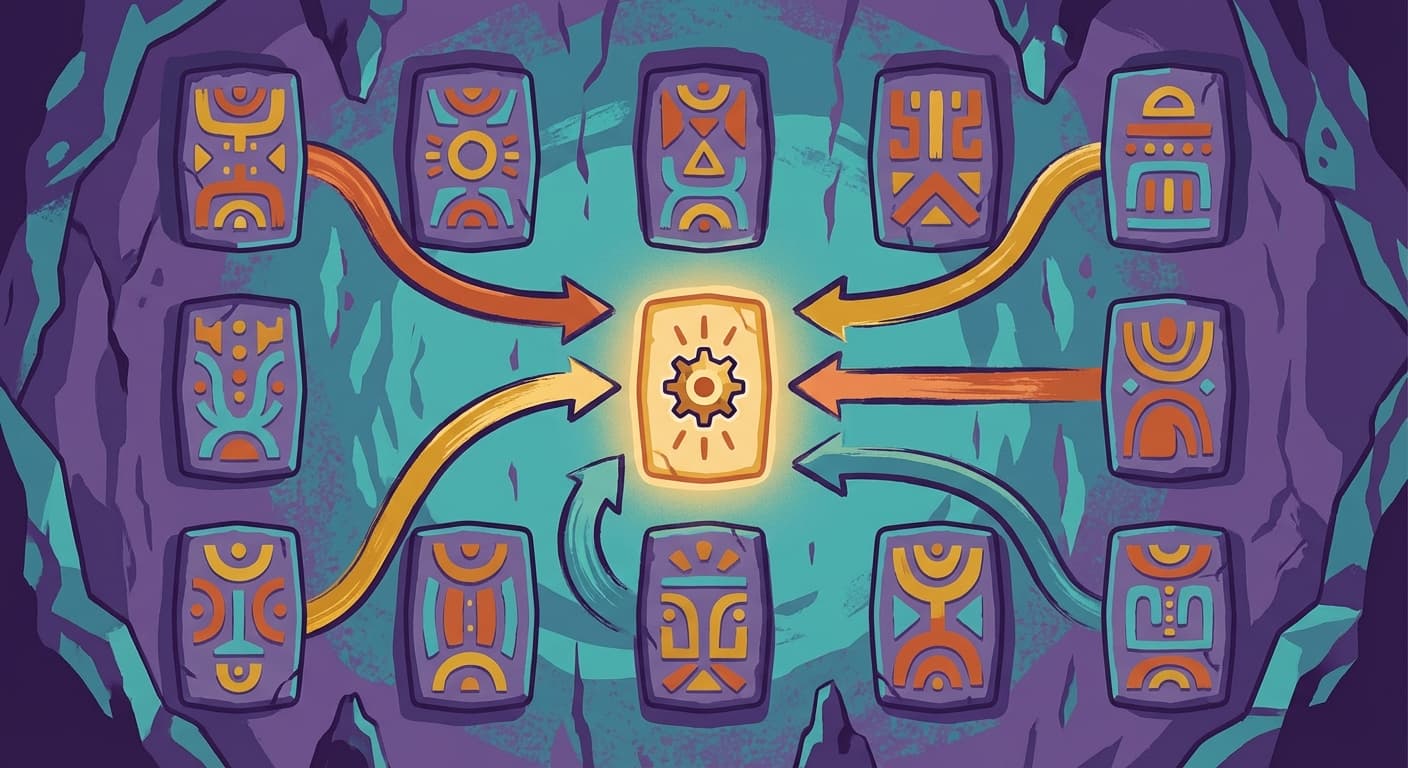
Glagalbagal carved a single tablet — the Carrying Tablet — containing the full carrying procedure for all five baskets. On the counting tablet, he replaced the three (now four) carrying steps with a single line:
Step 4. Follow the Carrying Tablet, then return to Step 5 of this tablet.
He did the same for the addition, subtraction, and every other tablet that involved carrying. Now, if he ever needed to change the basket configuration again, he would update one tablet instead of six.
The Lost Velociraptor
The system worked beautifully — for Glagalbagal, who understood the intent. For Krothva, it produced a new problem.
Krothva was performing an addition. She reached Step 7 of the Addition Tablet: "Follow the Carrying Tablet." She walked to the Carrying Tablet, read it, executed the carrying procedure. Then she stopped.
Krothva: I have finished the Carrying Tablet. Now what?
Glagalbagal: Return to the Addition Tablet. Step 8.
Krothva: Which tablet is the Addition Tablet? There are nine tablets on this wall.
Glagalbagal had written "follow the Carrying Tablet, then return to Step 8 of this tablet." But "this tablet" was ambiguous when Krothva was standing in front of the Carrying Tablet. She had no way to remember which tablet she had come from, or which step she had been on.
The Marker Stone
The fix was physical. Before following a reference tablet, the velociraptor would place a small coloured stone on the tablet she was leaving, positioned next to the step she should return to. When the reference tablet was complete, she would look for her coloured stone, walk to the tablet it was sitting on, and resume from the marked step.
Glagalbagal tested this. Krothva performed the addition, reached Step 7, placed her blue stone next to Step 8, walked to the Carrying Tablet, completed it, found her blue stone, returned to Step 8 of the Addition Tablet, and continued. It worked.
It even worked with nesting — the Carrying Tablet itself referenced a small Overflow-Check Tablet that verified whether a basket had exceeded its capacity. Krothva placed her blue stone on the Carrying Tablet, followed the Overflow-Check Tablet, returned, and eventually found her way back to the Addition Tablet. The stones formed a trail.
The Circular Path
But one afternoon, a new velociraptor named Gnjuk was performing a calculation when something went wrong. Glagalbagal had recently added a shortcut to the Overflow-Check Tablet: when a carry cascaded through multiple baskets, it referenced the Carrying Tablet to handle each cascade. This seemed efficient — why duplicate the carrying logic when the Carrying Tablet already contained it?
The problem was that the Carrying Tablet already referenced the Overflow-Check Tablet. Now the Overflow-Check Tablet referenced the Carrying Tablet back. Gnjuk followed the Carrying Tablet to the Overflow-Check Tablet, which sent him back to the Carrying Tablet, which sent him to the Overflow-Check Tablet again. He bounced between the two tablets, placing marker stones each time. By the time Blortz found him, there were over forty marker stones piled on the two tablets and Gnjuk was showing signs of existential confusion.
Blortz: The tablets are sending him in circles. Each one points to the other.
Glagalbagal removed the shortcut from the Overflow-Check Tablet and wrote the cascade logic directly, breaking the circular reference. He also added a rule for all velociraptors: if you have placed more than ten marker stones without returning to the first one, stop and report the situation. Another safety limit — the same principle as the timeout from Part 12, applied to a different kind of runaway process.