
Part 15 of 39
The Two-State Basket
By Madhav Kaushish · Ages 10+
With the Thjervak Plains operational and instruction tablets governing every procedure, Glagalbagal's system had reached an impressive scale. Dozens of velociraptors across four major locations counted, added, subtracted, multiplied, and divided daily, following carved instructions without Glagalbagal's direct involvement. The system worked. Except when it didn't.
The Error Problem
Blortz had been tracking mistakes. Every month, he compared velociraptor-produced arrangements against spot checks — recounts done by a separate, specially trained velociraptor named Thjikva, who was slow but meticulous. The discrepancy rate was troubling.
Basket 1, which could hold up to eight pebbles, produced errors about fifteen percent of the time. A velociraptor would glance at a basket containing six pebbles and record seven, or see seven and trigger a carry when none was needed. Basket 2 (capacity five) had an error rate of around eight percent. Basket 3 (capacity four) was the best at roughly five percent. Basket 5 — the new one, capacity six — sat at about ten percent.
The pattern was clear. More pebbles in a basket meant more opportunities to miscount. A velociraptor staring at a basket containing seven pebbles had to distinguish it from six pebbles and from eight. Under time pressure, with dozens of animals filing past, the distinction was not trivial.
The Training Solution
Glagalbagal's first response was to train the velociraptors better. He ran a two-week programme (administered by Qveshna, who approached it with her characteristic intensity) in which each velociraptor practised counting baskets under timed conditions. Error rates improved slightly. Basket 1 dropped from fifteen to twelve percent. The other baskets showed similar modest gains.
But the errors never reached zero, and with the volume of calculations across the Thjervak Plains alone, even a five percent error rate meant dozens of wrong results per month. Some of these errors cancelled out. Others cascaded through additions and multiplications, producing final totals that were significantly off. Another winter feed shortage was, statistically, only a matter of time.
Qveshna: The problem is not the velociraptors. I have trained them as well as they can be trained. The problem is the task. You are asking them to distinguish six objects from seven objects at a glance. That is genuinely difficult.
Blortz's Question
Blortz, who had been staring at the error data, asked a simple question.
Blortz: What is the fewest number of pebbles a basket could hold while still being useful?
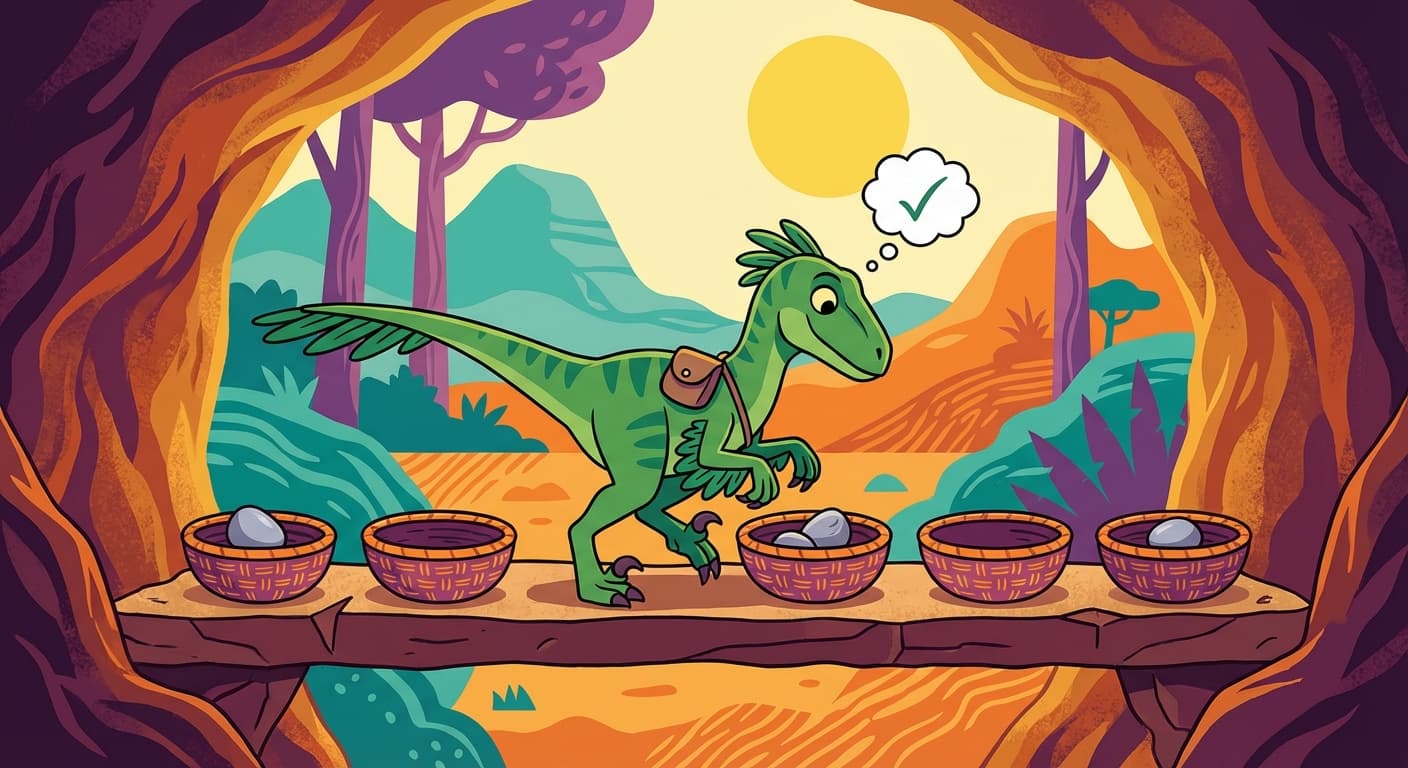
A basket that was always empty carried no information — it was useless. A basket that could contain zero or one pebble carried the minimum possible information: either the pebble was there or it was not. A velociraptor would never need to count. It would only need to look and see: pebble, or no pebble.
Glagalbagal: A basket with at most one pebble can only represent two states. That is almost nothing. You would need dozens of baskets to represent what four baskets represent now.
Blortz: But a velociraptor would never confuse "pebble" with "no pebble." The error rate would be essentially zero.
The Compromise That Failed
Glagalbagal was not convinced that the tradeoff was worth it. He tried a middle ground: base-four baskets, where each basket could hold zero, one, two, or three pebbles. This cut the states from eight to four — a substantial simplification.
He retrained the velociraptors on the new system. Error rates dropped to around three percent for each basket. Better, but not zero. Velociraptors still occasionally confused two pebbles for three, particularly when working quickly.
He tried base-three. Each basket held zero, one, or two pebbles. Error rate: roughly one percent. Still not zero. Under pressure, a velociraptor could still glance at a basket and misjudge whether it contained one pebble or two, especially if the pebbles were small or oddly shaped.
Only base-two — pebble or no pebble — brought the error rate to effectively zero. There was nothing to count. Nothing to confuse. The velociraptor's task reduced to a single binary question: is there something in this basket, or is it empty?
The Conversion
Glagalbagal committed to the conversion. He replaced his entire basket system with two-state baskets. The counting procedure changed: instead of "add one pebble to basket 1, carry at eight," it became "if basket 1 is empty, place a pebble; if basket 1 has a pebble, empty it and carry to basket 2." The carry happened at two, for every basket. No exceptions. No mixed radix. Every basket worked identically.
The uniformity was a revelation. His old system had baskets carrying at 8, 5, 4, and 6 — four different thresholds, four different rules. Every instruction tablet had to specify each threshold. Now there was one rule: carry at two. The Carrying Tablet shrank from a page of special cases to three lines. The instruction tablets for addition, subtraction, and multiplication all became simpler.
The cost was length. The number seven — previously just seven pebbles in one basket — was now represented across three baskets: pebble, pebble, pebble (what we would write as 111 in binary, meaning 4 + 2 + 1). A hundred and sixty, which had been a single pebble in the fourth basket, now required eight baskets. The arrangements were longer, the shelves in the record cave needed extending, and Blortz complained about the additional bookkeeping.
But the errors vanished. Over the first month of the new system, Thjikva's spot checks found zero discrepancies. Not a single miscounted basket. The velociraptors, freed from the burden of actually counting, were faster too — a glance was quicker than a count.