
Part 17 of 39
The Cave of Records
By Madhav Kaushish · Ages 10+
Glagalbagal's binary system was accurate, his Boolean logic was sound, and his instruction tablets governed every routine calculation. The business was running well. Then Thvajjik came back.
The Audit
The tax collector arrived unannounced on a Tuesday — or whatever the local equivalent was; the sources call it Grjepdag, which was traditionally considered an unlucky day for financial dealings. Thvajjik was conducting what he called a retrospective audit. He wanted to verify that the tax Glagalbagal had paid six months ago was correct, which meant he needed to see the herd count from that month — specifically, Location 2's count from the Smujka before last Hrijpa.
Thvajjik: Produce the record.
Glagalbagal: Of course. Give me a moment.
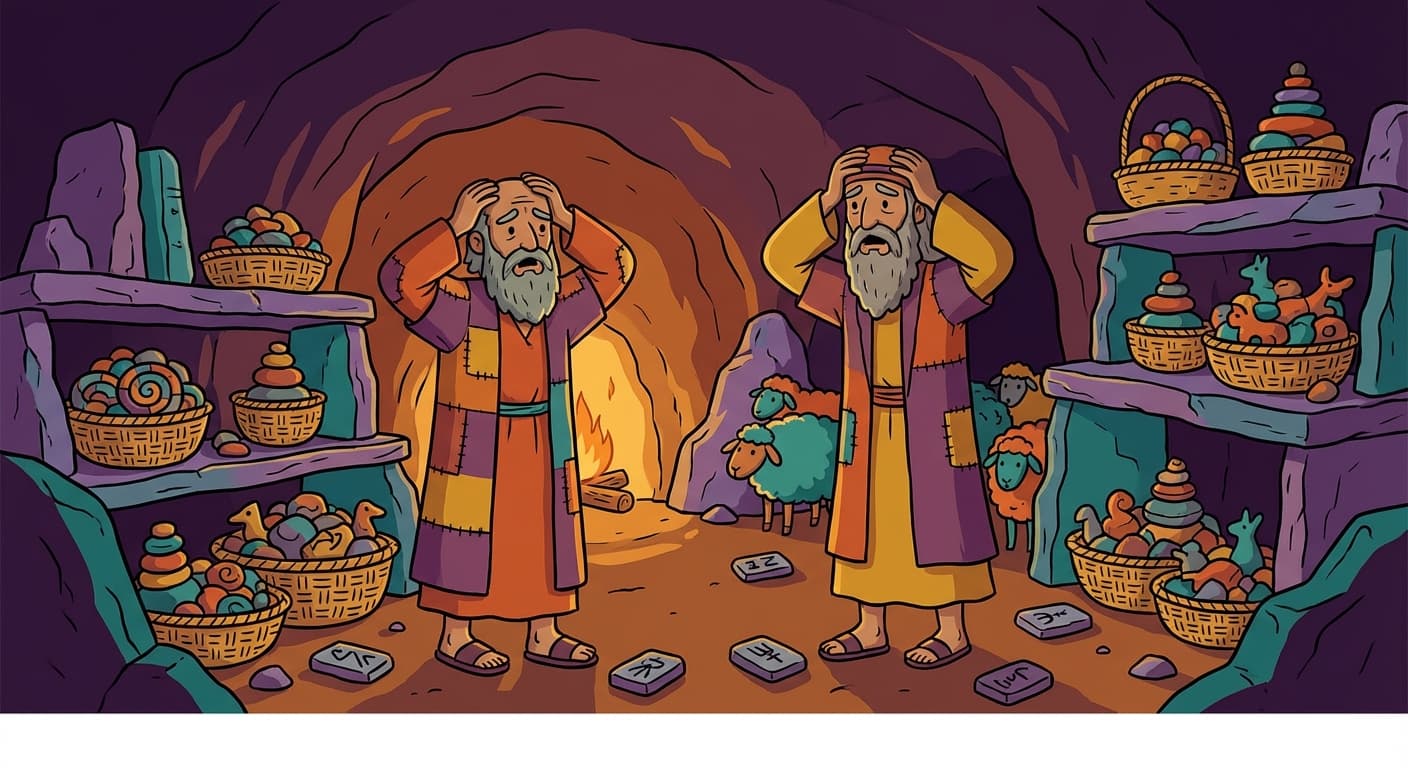
The moment lasted four hours. Glagalbagal's record cave contained hundreds of pebble arrangements on stone shelves. Some were labeled. Some had labels that had fallen off and were lying on the floor, their adhesive — a paste made from tree sap and ankylosaur saliva — having dried out. Some arrangements had been placed on shelves by velociraptors who did not share Glagalbagal's sense of spatial organisation, which, to be fair, was itself not particularly strong.
Glagalbagal eventually found an arrangement that he believed was Location 2's count from the relevant month. He handed it to Thvajjik, who copied it down and left.
The Fine
A week later, a carrier pterodactyl arrived with a notice. The record Glagalbagal had provided did not match the tax payment. The discrepancy was significant. After investigation, Thvajjik determined that Glagalbagal had handed over Location 1's count, not Location 2's — the arrangements had been stored on adjacent shelves with no labels, and he had grabbed the wrong one.
The fine was substantial. Glagalbagal paid it in cattle, which Thvajjik accepted with his usual bovine indifference.
The Shelving System
The problem was obvious: Glagalbagal had been storing records without any consistent system. Arrangements went on whichever shelf had space. Finding a specific record required remembering where it had been placed, which, after hundreds of records accumulated over years, was not realistic.
Blortz proposed an organisation based on two properties that every record had: which location it came from, and when it was created.
Blortz: Dedicate one shelf to each location. Within each shelf, arrange records in order by date — oldest at the left, newest at the right.
Glagalbagal spent a full week reorganising the cave. Shelf 1: Location 1, all records in date order. Shelf 2: Location 2. Shelf 3: Location 3. Shelf 4: Thjervak Plains (which, being the newest and largest location, already had the most records). Each record received a carved stone label listing the location and date.
When Thvajjik returned for another audit two months later, Glagalbagal walked directly to Shelf 2, counted to the appropriate position in the date sequence, and produced the correct record in under a minute. Thvajjik seemed almost disappointed.
The Two-Shelf Problem
But the clean system created a new difficulty. Some records belonged to more than one category. The quarterly tax summary for Location 2 was relevant both to "Location 2's history" and to "all tax records." The annual growth comparison across locations was relevant to every location simultaneously. Where should these records live?
Glagalbagal's first instinct was to make copies — place one copy on Shelf 2 and another on a new Shelf 5 designated for tax records. But Blortz objected.
Blortz: If you correct an error on one copy, you must remember to correct the other. If you forget, the two copies will disagree. And you will not know which one is right.
Glagalbagal had seen this exact problem before — duplicated carrying rules across instruction tablets (Part 13). The same principle applied: never store the same information in two places if you can avoid it.
The Reference Tablet
The solution was also familiar. Instead of copying the actual record, Glagalbagal placed a small reference tablet on Shelf 5 that read: "The tax summary you are looking for is on Shelf 2, position 14."
The reference tablet contained no data of its own. It was a pointer — a note that told you where to find the real record. If the real record was corrected, the correction existed in exactly one place, and anyone following the reference tablet would find the current version.
Glagalbagal extended this approach. He created a Shelf 6 for "Annual Comparisons" and populated it entirely with reference tablets pointing to records on Shelves 1 through 4. The annual comparison shelf contained no pebble arrangements at all — only directions to other shelves.
The cave now had a structure: primary shelves organised by location and date, and secondary shelves organised by purpose, containing only pointers. Any record could be found by location (go to the appropriate primary shelf) or by purpose (go to the appropriate secondary shelf and follow the pointer).