
Part 29 of 39
Computing for Hire
By Madhav Kaushish · Ages 10+
Glagalbagal's reputation had grown beyond his control. Hjelvran told his trading partners. Grothvik told other healers. Plomkva told the chieftain's construction bureau. Word spread through the regional gossip network — which, in this part of the world, was operated by Hyjop the triceratops, who could not keep a secret to save her considerable life.
Within six months, Glagalbagal had received inquiries from eleven different people who wanted what he had: a system for tracking, calculating, and querying structured information. These included three shepherds, two traders, a boat-builder, a taxidermist (the sources are not clear on why a taxidermist needed a data management system, though the volume of specimens was reportedly large), and, inevitably, Thvajjik the tax collector, who wanted Glagalbagal to run the regional tax calculations for all livestock owners — a task Thvajjik had been performing manually with the enthusiasm of a brontosaurus doing anything.
The Scaling Problem
Glagalbagal's cave had the shelves, the instruction tablets, the velociraptors, and the protocol. But it had been designed for four customers. Eleven more would require more shelves, more velociraptors, more pterodactyls, and a larger cave.
Building a separate system for each customer was impractical. Each customer would need their own cave, their own velociraptors, their own instruction tablets. Most of the infrastructure would be identical — the binary encoding, the Boolean operations, the addition and comparison procedures — duplicated eleven times.
Blortz: You do not sell each customer a cave. You let them use yours.
Glagalbagal: They would need their own shelves. Their own records. Their own lookup tablets.
Blortz: Yes. But they would share the velociraptors, the instruction tablets, the indexes, the protocol. The machinery is the same. Only the data is different.
This was the idea. Glagalbagal would not build eleven systems. He would expand one system to serve eleven customers. Each customer would get a dedicated section of the cave — their own shelves, their own lookup tablets, their own record space — but the velociraptors, the procedures, and the communication protocol would be shared.
The Pricing
The next question was how to charge. Blortz, who had been managing Glagalbagal's books since Part 1 and had developed a keen instinct for economics, proposed three options:
Option 1: Flat monthly rate. Each customer pays the same amount regardless of how much they use.
Option 2: Per-record rate. Customers pay based on the number of records stored and queries processed.
Option 3: Per-pebble rate. Customers pay based on the total number of pebble operations — additions, comparisons, lookups — their tasks require.
Glagalbagal: The flat rate is simplest.
Blortz: The flat rate is simplest and the most unfair. Thvajjik's tax calculations will consume more velociraptor time in one month than the taxidermist will use in a year. Should they pay the same?
Glagalbagal: Then per-record.
Blortz: The boat-builder stores few records but runs complex calculations on each one — structural analyses that require hundreds of operations. The shepherd stores many records but runs simple counts. Per-record undercharges the boat-builder and overcharges the shepherd.
They settled, after considerable argument, on a hybrid: a base monthly rate for shelf space (storage), plus a per-operation rate for velociraptor time (computation). This meant customers who stored a lot but computed little paid mostly for storage. Customers who stored little but computed heavily paid mostly for computation. The pricing reflected the actual resources consumed.
The Service
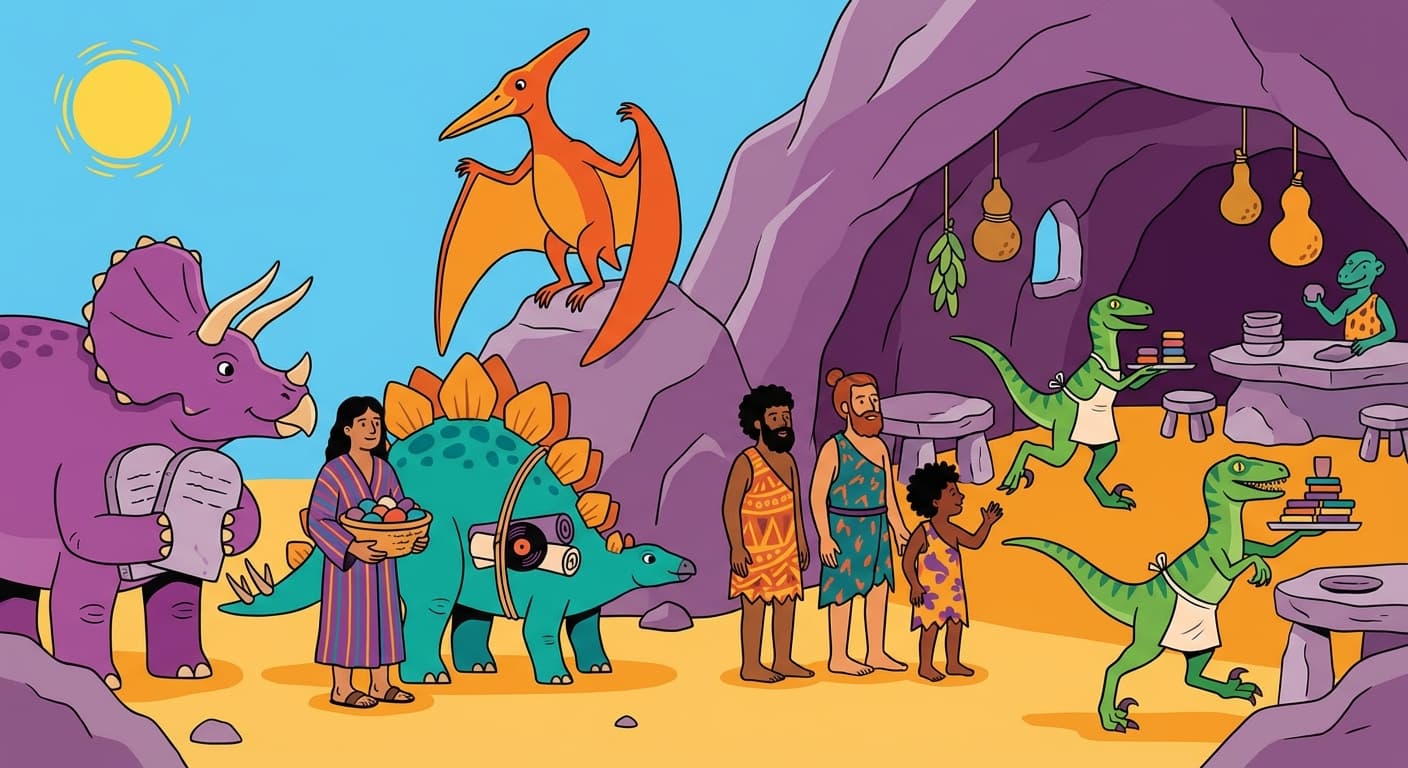
Glagalbagal named the service — after some deliberation and Blortz's veto of the first fourteen names, which ranged from the grandiose ("The Universal Repository of All Knowledge") to the absurd ("Blortz's Pebble Hut") — GlagalCloud. The name was Hyjop's suggestion, delivered as gossip: "Glagalbagal's thing, you know, the cave where everyone sends their pebbles, like a cloud of pterodactyls going in and out." The name stuck, despite making no particular sense.
The operational structure was straightforward:
Customers send data to GlagalCloud via pterodactyl, following the message protocol. GlagalCloud velociraptors receive the data, validate it, and store it on the customer's designated shelves. Customers send queries — "how many cattle do I have at Location 2?" — also via pterodactyl. Velociraptors process the query using the shared instruction tablets and the customer's data. Results are sent back via pterodactyl.
The customer never touched a velociraptor. Never entered the cave. Never saw the shelves or the instruction tablets. They sent data in, asked questions, and got answers back. The mechanism was invisible; only the results mattered.
The First Week
The first week went smoothly. Seven of the eleven customers had submitted their initial records. Velociraptors were assigned to incoming message processing in the morning and query processing in the afternoon. Blortz managed the shelf allocation. Glagalbagal handled the new-customer setup — creating lookup tablets and header definitions for each customer's domain.
Thvajjik's tax calculations, as predicted, consumed more velociraptor time than all other customers combined. The per-operation pricing meant he paid accordingly, which he accepted with his usual bovine equanimity. The taxidermist's data was minimal but oddly specific (each specimen required fields for species, preservation method, eye colour, and "cause of death if known," which was a field Grothvik the healer also found useful, though for different subjects).
By the end of the first month, GlagalCloud was processing roughly two hundred records per day and answering fifty queries. The cave was busier than it had ever been. The velociraptors were earning more in per-operation fees than Glagalbagal's livestock business had generated in profit.
Blortz: You are making more money from managing other people's pebbles than from managing your own sheep.
Glagalbagal: That cannot be right.
Blortz: It is right. I have the records.
Glagalbagal: Of course you do. You always have the records.