
Part 6 of 39
The Unfair Reward
By Madhav Kaushish · Ages 10+
Glagalbagal's four-month evaluation system was working. But his business continued to grow, and he opened a third location — a small outpost in the hills, managed by a pterodactyl named Qveshna. The hill location was new and started with a small herd, while the two valley locations had been operating for years and had large herds.
The First Evaluation
After the first four-month period, Glagalbagal compared the starting and ending arrangements for each location. Location 1, under Frojj, had the largest growth — roughly twenty new animals. Location 2, under Mvantika, had grown by about twelve. Location 3, under Qveshna, had grown by eight.
Glagalbagal ranked them: Frojj first, Mvantika second, Qveshna last. He awarded Frojj a barrel of Grtizki — the alcoholic drink made from Megalodon bile that had become the standard prize — and publicly congratulated him at the Smujka festival.
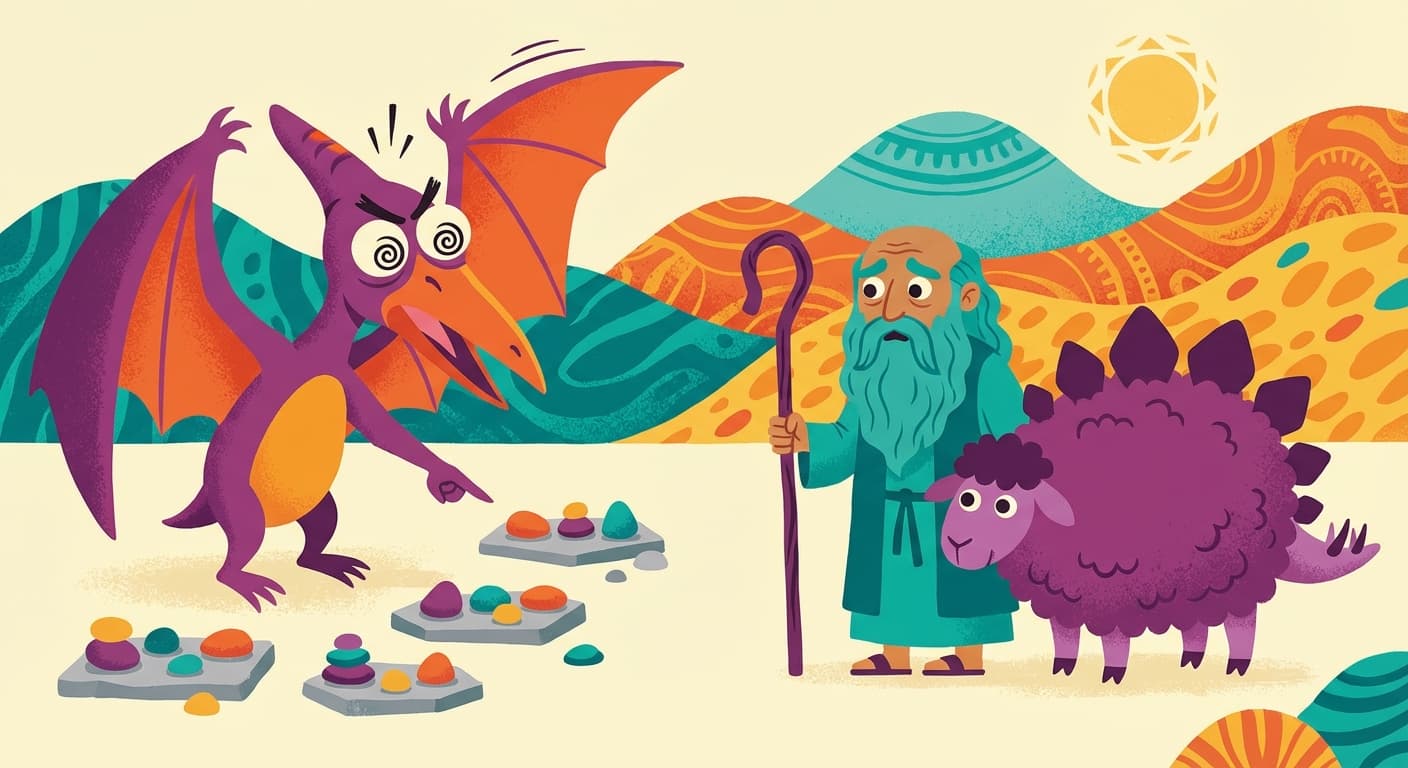
Qveshna flew down from the hills in a rage.
The Protest
Qveshna: You gave me twenty animals to start with. Frojj started with over a hundred and fifty. Of course his herd grew by more — he has more animals that can breed.
Glagalbagal: Twenty more animals is twenty more animals. What is there to argue about?
Qveshna: Give me a hundred and fifty animals and I will grow the herd by far more than twenty.
Glagalbagal: That is easy to say.
Qveshna turned to Blortz, who had been arranging pebbles nearby.
Qveshna: Blortz. Suppose Glagalbagal gave you two sheep and you returned four. And suppose he gave Frojj a hundred sheep and Frojj returned a hundred and ten. Who did a better job?
Blortz thought about it. He had gone from two to four — the herd would have doubled. Frojj had gone from a hundred to a hundred and ten — barely a change. Clearly the first case was better.
Blortz: The person with two sheep.
Qveshna: But the person with two sheep only grew the herd by two. Frojj grew it by ten. By Glagalbagal's rule, Frojj wins.
The Problem
Glagalbagal saw the issue. The absolute size of the growth — how many animals were added — did not capture how well the manager had performed, because it depended entirely on how many animals the manager had started with. A large herd almost guaranteed more growth in absolute terms, simply because there were more animals that could reproduce. Comparing twenty new animals from a herd of a hundred and fifty to eight new animals from a herd of twenty was not a fair comparison.
What he needed was a way to measure growth relative to the starting size. But how? He did not have division or fractions. He had only his pebble arrangements and his method of one-to-one matching.
The Failed Attempt
Glagalbagal's first idea was to ignore the starting size entirely and simply reward whichever herd had the highest month-to-month growth. But this was exactly the system that had just been shown to be unfair. He went in circles for several days.
The Solution
The solution, as usual, came from a tool Glagalbagal already possessed. He could match two collections one-to-one. He decided to use this to answer a specific question: for each new animal born, how many animals had the manager started with?
He laid out the starting arrangement for Location 3. Twenty starting pebbles. Eight growth pebbles. He divided the twenty starting pebbles into groups, one group per growth pebble — eight groups. Each group contained two pebbles, with four left over. So for roughly every two or three starting animals, Qveshna had produced one new animal.
He did the same for Location 1. A hundred and sixty starting pebbles. Twenty growth pebbles. He divided the starting pebbles into twenty groups. Each group contained eight pebbles, none left over. For every eight starting animals, Frojj had produced one new animal.
The comparison was now obvious. Qveshna needed only two or three existing animals to produce each new one. Frojj needed eight. Qveshna had been dramatically more effective all along.
The Revised Ranking
Glagalbagal recalculated for all three locations. Qveshna: roughly two and a half starting animals per new animal. Mvantika: roughly seven. Frojj: eight. The ranking reversed completely.
Glagalbagal sent a carrier pterodactyl to Frojj requesting the barrel of Grtizki back. Frojj, who had already consumed most of it, was not pleased. (This incident led to the establishment of a new company policy: prizes would be awarded only after the four-month evaluation, with a two-week verification period. The policy was nicknamed the Grtizki Rule.)