
Part 18 of 43
Push and Pull
By Madhav Kaushish · Ages 12+
Crivsola visited Lomytguya the following week. The prison visiting rules in Sonhlagot were characteristically absurd — visitors were permitted only on days when the moon was not visible, which the authorities interpreted as cloudy nights, creating a system where visiting hours depended entirely on the weather.
It happened to be overcast, so Crivsola was allowed in.
The Problem
She explained her findings to Lomytguya through the cell bars. The body had a rigid frame. Soft pulling-strings attached to the frame could shorten and harden, pulling frame-pieces together across a joint. This was how the body moved.
"But the strings can only shorten," Crivsola said. "They can pull, but they cannot push. When I bend my arm, the front string contracts. But to straighten the arm again, simply relaxing the front string is not enough. The arm goes limp — it does not spring back."
Lomytguya leaned against the wall of her cell. She had lost weight since Crivsola's release, but her mind was as sharp as ever. "So how does it straighten?"
"There is a second string on the opposite side. When the back string shortens, it pulls the arm straight. The front string relaxes to let it happen."
The Rope Principle
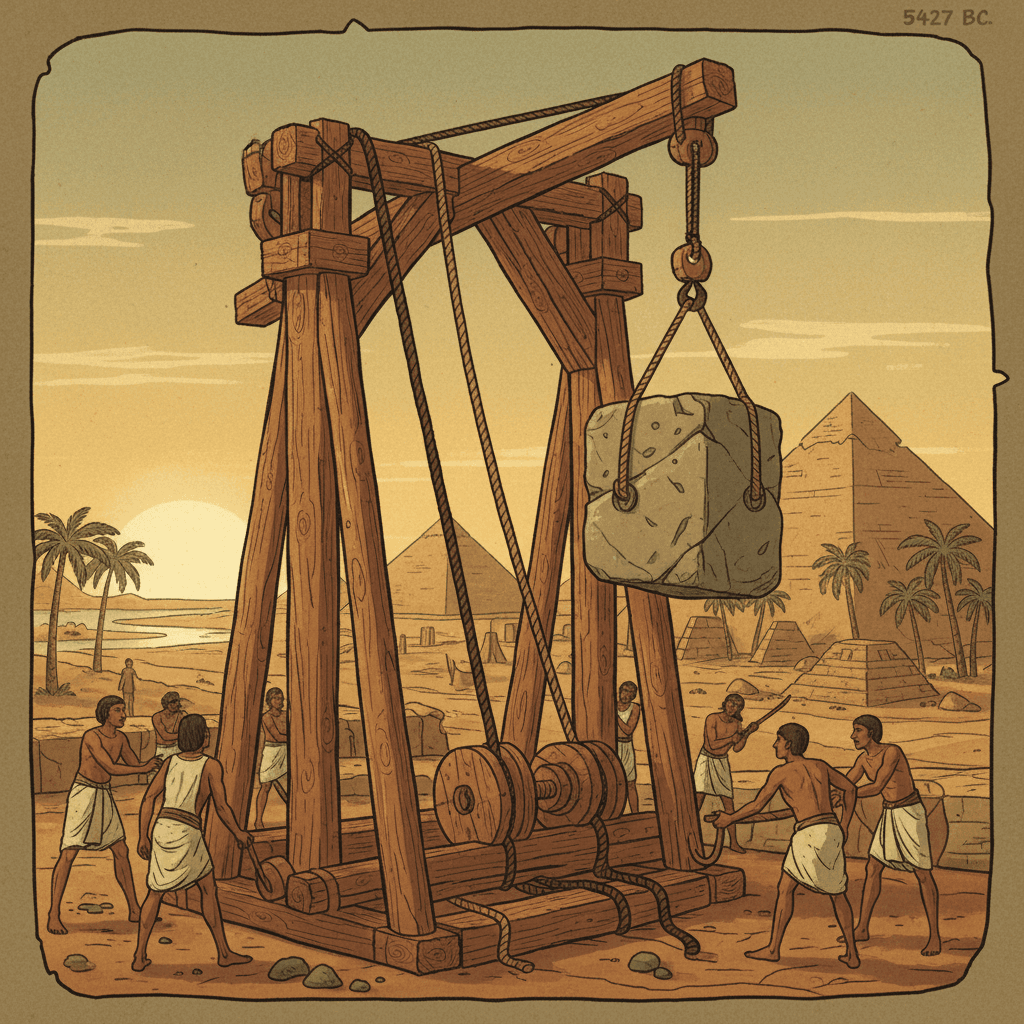
"This is obvious, when you think about it," Lomytguya said. "We had cranes at the factory. A crane lifts a load with a rope. The rope can pull the load up, but it cannot push the load down. If you want to lower the load in a controlled way, you need a second rope pulling from below."
Crivsola nodded. This was exactly right. A string that could only shorten was like a rope that could only pull. For every direction of movement, you needed a separate string pulling that way.
At every joint, there must be at least two pulling-strings — one for each direction of movement.
Bend the elbow: front string pulls. Straighten the elbow: back string pulls. Neither could do the other's job. They worked as a pair — when one contracted, the other relaxed.
The Design Requirement
This was more than an observation. It was a deduction about how the body had to be built, given one simple fact about the pulling-strings.
The fact: pulling-strings can shorten but cannot lengthen under their own power.
The consequence: every joint needed opposing strings. A hinge joint that moved in one plane needed at least two — one for each direction. A ball-in-cup joint that moved in many directions would need many more, arranged around the joint to cover every possible movement.
"The shoulder must be surrounded by pulling-strings," Crivsola said, pressing around her own shoulder. She could feel them — soft masses on every side of the joint, each one presumably responsible for pulling the arm in a different direction.
The Deeper Question
Lomytguya had been quiet for a moment. Then she said, "This is all very elegant. But you have told me what the strings do. You have not told me what tells them to do it."
"Tszuvok asked the same thing."
"Because it is the obvious question. When you decide to bend your arm, something must carry that decision from wherever decisions are made to the specific pulling-string that needs to shorten. How? You said the body has internal rivers that carry food-power to every part. Do they also carry instructions?"
Crivsola had not thought of it in those terms. The question of what controlled the strings — what sent the signal to contract — was important, but it was a question for another day. Right now, something else was nagging at her.
The pulling-strings did work. They shortened, hardened, relaxed, over and over, all day long. Work required power. Where did that power come from?
She thought she already knew the answer. But it had implications she had not fully considered.