
Part 20 of 43
The Fuel Question
By Madhav Kaushish · Ages 12+
Crivsola spread her notes across the floor of her study. Months of work, scratched onto parchment and prison walls and scraps of paper, now assembled into a single picture. She wanted to see it all at once.
The Inventory of Needs
She began listing everything the body did that required power.
The pulling-strings shortened and relaxed, thousands of times a day, to move the frame. The frame itself — alive, as Tszuvok's broken arm had proved — grew in children, mended after injury, and maintained itself continuously. The dissolving chamber produced its dissolving liquid to break food apart. The sieve-walls sorted useful material from waste and pushed it through. The protective lining that kept the dissolving liquid from eating through the body's own walls had to be constantly renewed.
Even generating warmth. The body was warm — warmer than the air around it, always. That heat had to come from somewhere.
"Everything requires fuel," Crivsola said.
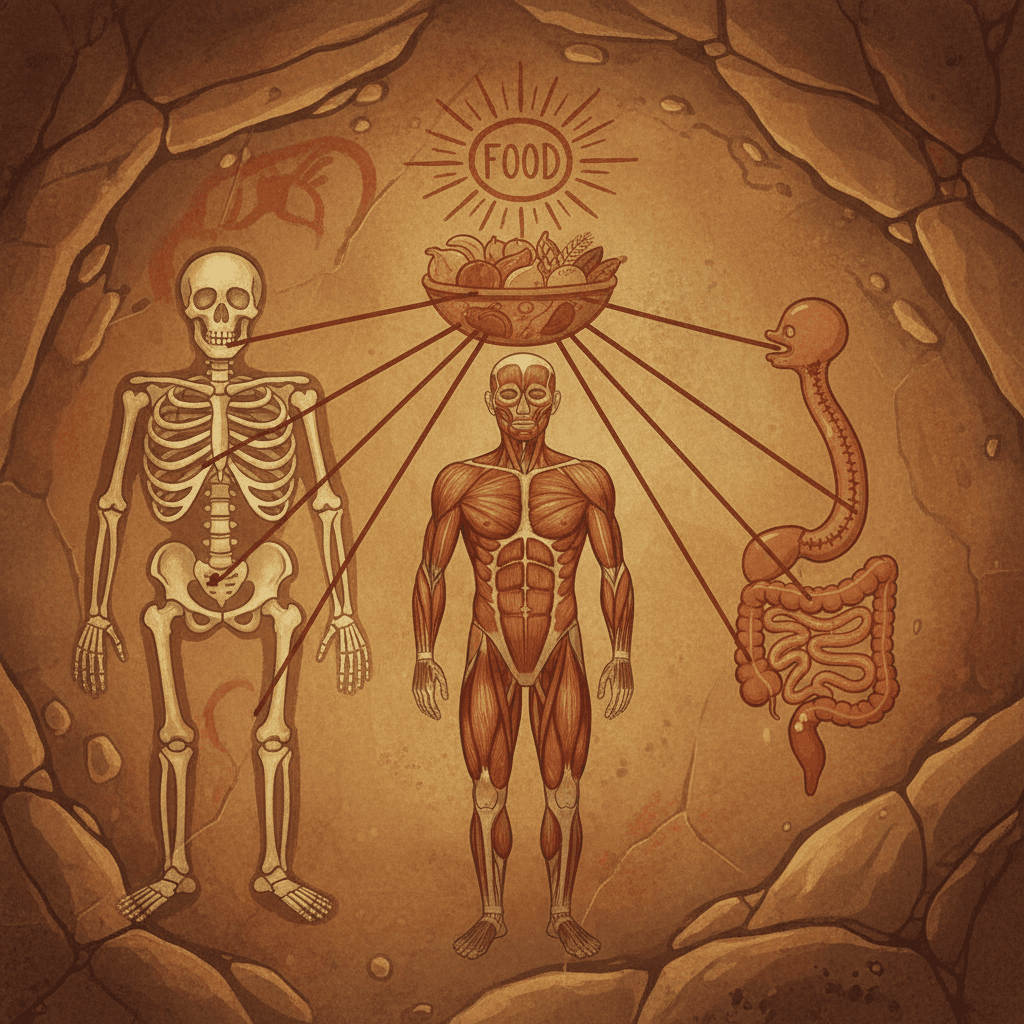
One Source
And there was only one source: food. Nothing else entered the body in sufficient quantity to account for all this activity. Air entered through the mouth and nose, and water was consumed, and those might play roles she did not yet understand. But the primary fuel — the substance the body broke down, sorted, and distributed — was food.
Food is not merely something the body processes. It is the fuel that powers everything the body does.
This reframed eating entirely. People did not eat simply to fill a void. They ate because every part of the body — from the pulling-strings in the fingers to the hard frame of the skull — was burning through fuel and needed constant resupply.
The Distribution Problem
But this created a problem. Food entered the body through the mouth and was broken down in the dissolving chamber. The sieve-walls allowed useful material to leak through into the body. So far, so good. But the pulling-strings in Crivsola's toes were very far from the dissolving chamber. The hard frame in Tszuvok's skull was even further.
How did the fuel get from the dissolving chamber to every distant corner of the body?
Crivsola had proposed an answer to this back in prison, months ago. Internal rivers — a network of channels carrying dissolved food-material to every part of the body, the way rivers carried water from mountains to distant fields.
The Rivers Must Exist
The logic was inescapable. Food was broken down in one place. Fuel was needed everywhere. Therefore, something must carry the fuel from where it was processed to where it was used. The internal rivers were not a guess — they were a requirement of the model.
The rivers must exist. The body cannot function without them.
Lomytguya had suggested the idea. The sieve-walls leaked useful material out of the tube. That material had to go somewhere. Rivers were the only mechanism that made sense — a branching network reaching every part of the body, delivering fuel and raw materials for growth and repair.
But prediction was not proof. Crivsola had deduced the rivers from logic. She had never detected them. She had no direct evidence — no observation, no measurement, no test that confirmed their existence.
The Next Question
She rolled up her notes and stared out the window at the rain running in channels along the rooftops, joining into streams that flowed to the gutters below. Rivers within the body. They had to be there. But what were they made of? What flowed through them? Could she find evidence for them from the outside — without cutting, without breaking the law that had already sent her to prison once?
She had a frame, pulling-strings, joints, a dissolving tube, sieve-walls, and a theoretical river network connecting it all. The model was becoming large and interconnected. Every new piece depended on the others.
Somewhere in the body, rivers were flowing. Crivsola intended to find them.