
Part 22 of 43
The Drum in the Chest
By Madhav Kaushish · Ages 12+
Crivsola pressed her palm against her chest and counted. The thumping was unmistakable — stronger than the pulse at the wrist, more insistent. Something in the chest was beating. She could feel it through her ribs.
"Put your ear against my chest," she told Tszuvok.
He looked uncomfortable, but did as she asked. His eyebrows rose. "It is loud," he said. "Like someone knocking on a door from inside."
The Pumping-Thing
So the source was in the chest. A pumping-thing — she had no better name for it — sat somewhere behind the ribs, beating rhythmically, pushing fluid through the channels she could feel at the wrist and neck. The ribs, she realized, might exist partly to protect it. A pump this important would need a cage around it.
This much seemed solid. But it raised an immediate question: what happened to the fluid after the pump pushed it out?
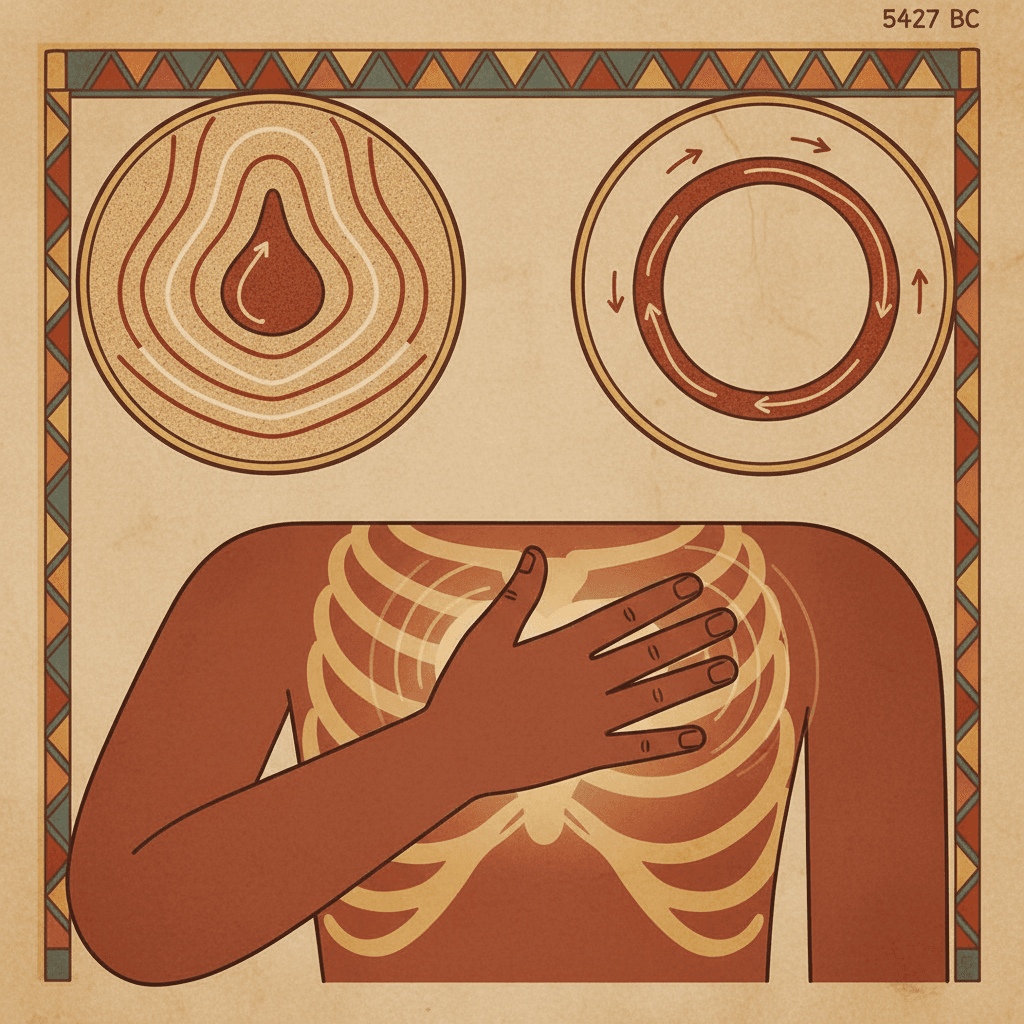
Two Models
Crivsola drew two pictures in the dust on her worktable.
In the first, the pump pushed fluid outward through channels, and the fluid gradually soaked into the body's tissues — the way water poured on sand spreads out and is absorbed. The fluid would leave the channels, soak into the surrounding flesh, and be consumed. She called this the Soaking Model.
In the second, the fluid traveled out through channels, delivered its fuel, and then returned to the pump through a second set of channels — going around in a continuous loop, the way water in an irrigation ditch could be routed back to its source. She called this the Loop Model.
Both models explained the pulse. Both explained how fuel reached distant parts of the body. The question was which one matched reality.
The Waste Problem
Crivsola thought about the Soaking Model first. If fluid was constantly being pushed out and absorbed, the body would need to produce an enormous quantity of it. Every beat of the pump sent fluid outward, and that fluid never came back. The body would need to manufacture replacement fluid as fast as it was consumed.
That is a tremendous amount of waste.
She thought of the wolf trap from prison — the one-way valve that had helped her understand how food stayed down during a headstand. That mechanism was efficient. It did not waste anything. It simply prevented backflow.
A body that soaked through its own fluid and discarded it with every heartbeat seemed profligate. Not impossible — but wasteful in a way that made Crivsola suspicious.
A Preference, Not a Proof
She was careful to note that her preference for the Loop Model was not proof. The body might very well be wasteful. Many things in Sonhlagot were — the government's filing system came to mind. But between two models that both explained the same observations, the one that did not require the body to be a bottomless factory of replacement fluid seemed more likely.
The Loop Model made a prediction. If the fluid went out and came back, there should be two types of channels — outgoing and returning. The pulse she felt at the wrist was in the outgoing channels, pushed along by each beat of the pump. But the returning channels should feel different. Quieter, perhaps. Less forceful.
She needed to look for them.