
Part 30 of 43
The Involuntary
By Madhav Kaushish · Ages 12+
Crivsola was making a list. She sat at her workbench with a sheet of paper divided into two columns. On the left she wrote things she could control. On the right, things she could not.
The Two Columns
The left column filled quickly. She could raise her arm, lower it, turn her head, open and close her hand, wiggle her toes, close her eyes, stick out her tongue. She could walk, sit, stand, bend, reach. Every one of these happened when she decided it should and stopped when she decided it should stop.
The right column was different. She could not stop the chest-pump. She had tried — sat perfectly still and willed it to pause. The thumping continued without the slightest hesitation. She could not halt the dissolving of food in her tube. Once she swallowed a meal, the process proceeded entirely without her involvement. She could not prevent sweating on a hot day or stop a wound from swelling.
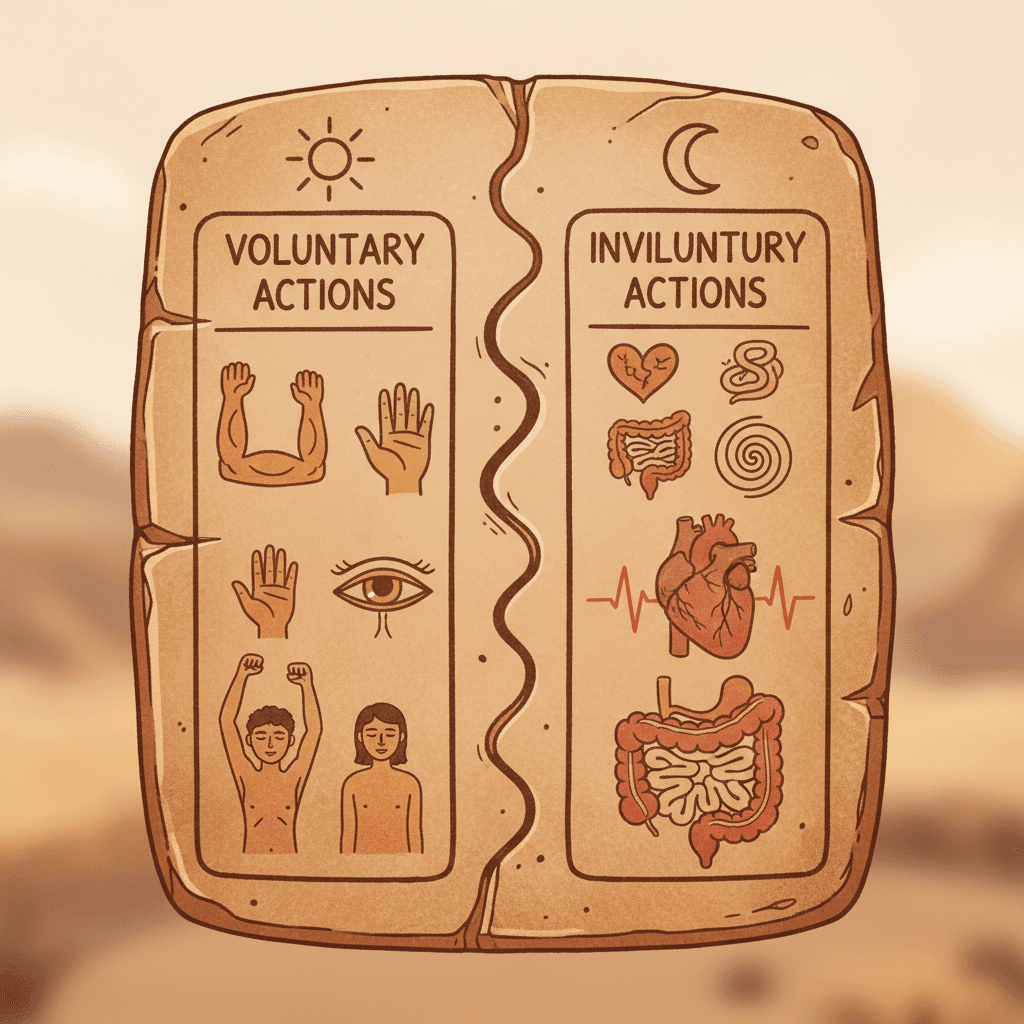
Then there was breathing. This fell into an odd middle ground. She could hold her breath — for a while. She could breathe faster or slower if she chose to. But she could not stop permanently. Eventually, something overrode her decision and forced her to breathe again, whether she wanted to or not.
The One Controller Problem
The simplest explanation was one controller — a single system that managed everything in the body, both the chosen actions and the automatic ones. But Crivsola saw the difficulty immediately.
If one controller ran everything, why could she override some commands but not others?
She could decide to raise her arm, and it went up. She could decide to stop her chest-pump, and nothing happened. The controller listened to her for some actions and ignored her completely for others. That was a strange way for a single system to behave.
Two Controllers
The more natural explanation was that there were at least two controllers. One handled the things she chose to do — moving her arms, turning her head, walking across a room. This controller took orders from her. When she decided to move, it moved.
The other handled the things that ran by themselves — the chest-pump, the dissolving of food, the passage of red fluid through its endless circuit. This controller did not take orders from her. It operated independently, keeping the essential machinery running whether she was paying attention or not. Whether she was awake or asleep. Whether she wanted it to or not.
The Foreman
Crivsola brought this to Lomytguya on her next prison visit. Lomytguya listened, then nodded slowly.
"Every factory has two kinds of workers," Lomytguya said. "The ones on the floor, who do what the foreman tells them. And the foreman herself, who keeps the whole operation running — the furnaces burning, the conveyor moving, the ventilation working. The floor workers can go home at night. The foreman never leaves."
"The body has a foreman," Crivsola said.
"A foreman who keeps the machines running even when the workers are not paying attention. Even when they are asleep. Even when they would rather the machines stopped."
Crivsola thought about people she had seen die. The chest-pump stopped. The breathing stopped. The automatic controller — the foreman — ceased its work. And once it stopped, no amount of willing, no decision by the conscious controller, could restart it.
The Next Question
She stared at her two-column list. Two kinds of control implied two controllers. But where were they? The chest-pump sat in the chest. The bellows surrounded it. The food tube ran from mouth to bottom. These were the machines. But the controllers — the systems that sent orders to the machines, telling them when to beat, when to breathe, when to dissolve — where did they reside?
And how did they send their orders? The chest-pump was in the chest, but she could move her fingers by thinking about it. Somehow, a decision made in one place resulted in action in another. There must be a way for signals to travel through the body — from the controller to the part being controlled.
If the body had two controllers — one for chosen actions and one for automatic ones — where were they? And how did they send their orders?