
Part 36 of 43
The Light Chamber
By Madhav Kaushish · Ages 12+
Brekvi had been thinking about Crivsola's dark room problem — the idea that the commander in the head never directly touched the world, receiving only messages from scouts at the body's surface. "If the head has scouts," he said, "then sight must be one of them. And I think I know how it works."
Crivsola had been considering the same question. She started with the simplest observations she could identify.
What Sight Requires
You cannot see in total darkness. Stand in a sealed cave with no torch and you see nothing — not a shape, not a shadow, not even the hand in front of your face. But the moment someone lights a flame, the world reappears.
You see from the front of the head, through two openings — the eyes. You do not see through your elbows or your knees. The scouts for sight, whatever they were, lived specifically in the eyes.
And the eyes had a curious feature. Crivsola had noticed it years ago but never thought about it carefully. The dark circle at the centre of each eye changed size. In bright sunlight, it shrank to a pinpoint. In dim rooms, it widened. It was an opening that adjusted itself.
Two Models
Two possibilities presented themselves.
The Beam Model: the eyes send out invisible beams that scan the world, the way a person in a dark room might sweep a torch back and forth. The beams strike objects and the eyes sense what they touch.
The alternative was simpler. The eyes do not send anything out. They receive something that comes in — light.
Both models explained ordinary seeing. But they made different predictions about one specific situation.
The Crucial Test
"If the eyes send out beams," Crivsola said, "then you should be able to see in total darkness. The beams come from you, not from outside. Darkness should not matter."
But darkness did matter. Absolutely and completely. In total darkness, nobody could see anything. She had experienced this herself in the prison caves beneath Sonhlagot — days of utter blackness in which her eyes were useless despite being wide open.
If sight depended on something the eyes sent out, darkness would not prevent seeing. But it does. Therefore sight depends on something coming in from outside — light.
The Beam Model was dead. One observation killed it.
The Hole in the Wall
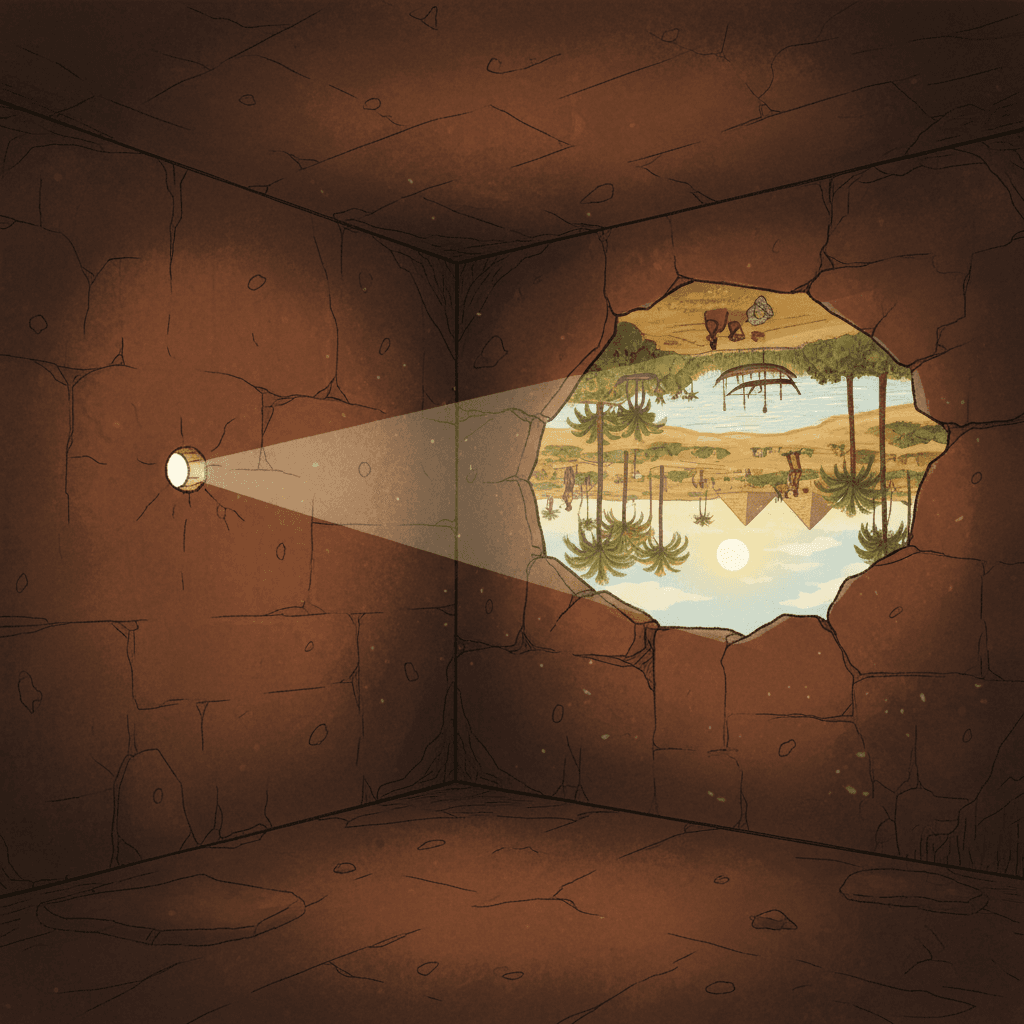
Brekvi had prepared a demonstration. He had sealed every crack in his workshop — covered the windows, stuffed cloth under the door — and punched a single small hole in one wall. The room was nearly black. But on the far wall, opposite the hole, something extraordinary appeared.
A picture. Faint, upside-down, but unmistakable — the street outside, the buildings, a cart passing by. All projected onto the wall in coloured light.
"Light travels in straight lines," Brekvi said. "It comes through the hole and continues straight, so the top of the scene hits the bottom of the wall and the bottom hits the top. The smaller the hole, the sharper the picture."
Crivsola stared at the inverted street scene. Then she looked down at her own hand and pressed a finger gently to her eyelid, feeling the round, firm shape beneath.
A Picture Inside
The eye was a dark chamber — a small sealed room with a tiny opening at the front. Light entered through that opening and created a picture on whatever surface lay at the back.
The eye is a light chamber. It lets light in through a small hole and forms a picture inside. That picture is what gets converted into a signal for the head.
The dark circle that changed size was the hole — widening in dim light to let more in, shrinking in bright light to prevent flooding. It was the same principle as Brekvi's workshop, miniaturised and built into the body.
The eye was a scout for the commander — a scout that gathered light and turned it into a message. But light was only one kind of information from the outside world. There were others. And the next one, Brekvi suggested, was something he knew even better than light.
Sound.