
Part 39 of 43
Illusions and Errors
By Madhav Kaushish · Ages 12+
Crivsola closed her eyes and pressed gently on the side of her right eyeball through the lid. A flash of light appeared — a pale, wobbling spot in the darkness behind her eyelid. There was no light. The room was dim, her eyes were shut, and nothing luminous was anywhere near her face. But she saw light nonetheless.
She pressed again. Another flash. The signal reaching her head was the same kind of signal that real light would produce. And the head — having no way to tell the difference — interpreted it as light.
The eye's detector could be triggered by the wrong thing. Pressure was not light. But pressure on the eye produced a signal, and the head read that signal the only way it knew how.
The Temperature Trick
She designed a second test. Three bowls of water — one hot, one cold, one warm. She placed her left hand in the hot water and her right hand in the cold. She held them there until both hands had adjusted. Then she moved both hands into the warm bowl at the same time.
Her left hand — the one that had been in hot water — felt cool. Her right hand — the one that had been in cold water — felt warm. The same water, at the same temperature, producing two different sensations in two hands at the same moment.
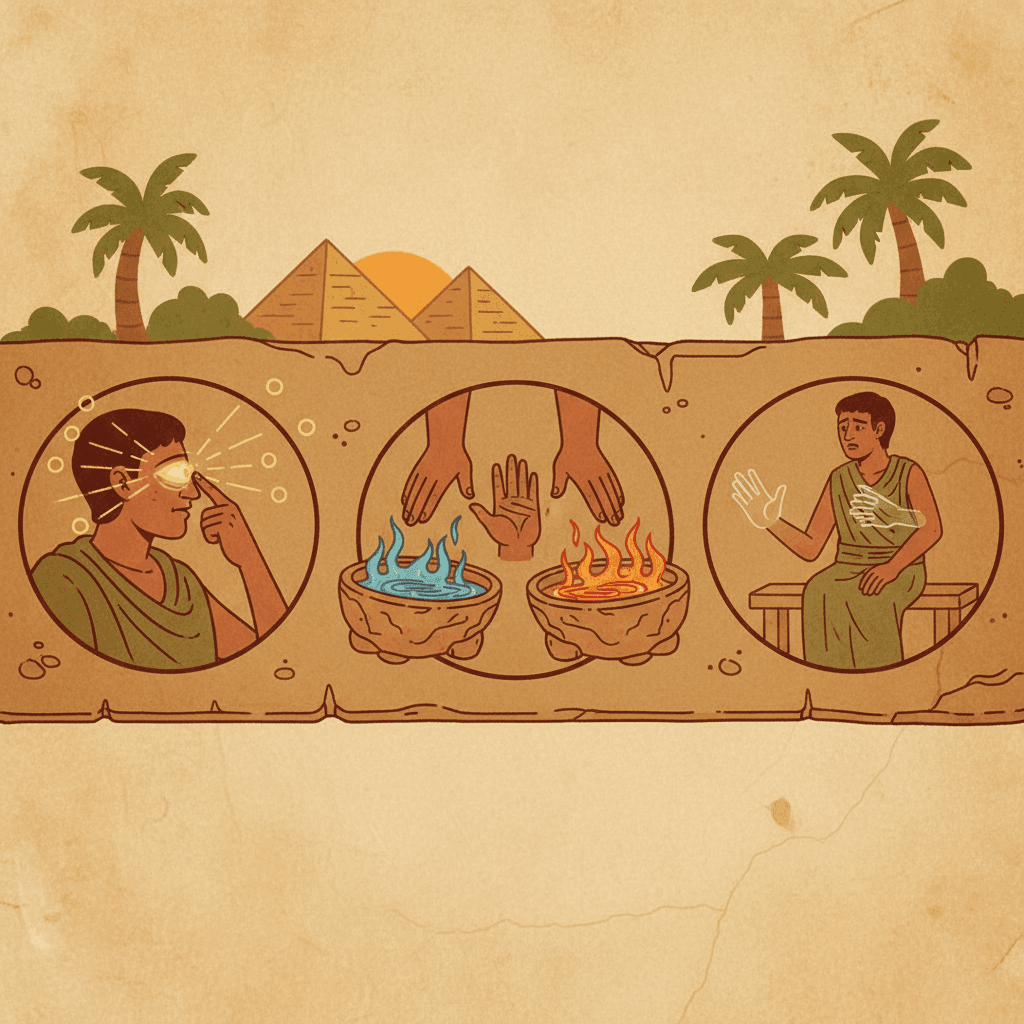
The skin does not measure temperature. It measures change in temperature.
The head received two conflicting reports from the same bowl of water and had no way to reconcile them. It simply reported what each hand told it. And what each hand told it was, in this case, wrong.
The Missing Hand
On her next visit to the prison, Crivsola mentioned the temperature trick to Lomytguya. Lomytguya nodded slowly, then said: "There is a man in the cell down the corridor. He lost his left hand in a quarry accident — crushed, removed at the wrist. He says he can still feel it."
"Feel what?"
"The hand. The fingers. He says they itch. He says they ache in cold weather. He says he sometimes tries to pick things up with a hand that is not there."
Crivsola sat very still. A man who had lost a hand could still feel it. Not metaphorically — he experienced genuine sensations of itching and pain from fingers that no longer existed.
This made perfect, terrible sense within her model. The hand was gone, but the paths — the signal-carrying paths that once ran from the hand to the head — were still there, ending in a stump. If those severed paths fired signals, the head would receive them and interpret them the only way it could: as messages from a hand. The head did not know the hand was gone. It only knew what the paths reported.
The head builds a picture of the body based on the signals it receives. If the signals are wrong, the picture is wrong — and the head has no way to know.
The Constructed World
Crivsola sat on the bench outside the prison and stared at the street. People walked past. Carts rolled by. A dog slept in the shade of a wall. She saw all of this — the colours, the shapes, the movement — and it felt utterly real. Solid. Certain.
But it was not certain. What she saw was a picture constructed by the commander in her head, assembled from signals sent by the scouts in her eyes. What she heard was another construction, built from signals sent by her ears. What she felt — the bench beneath her, the warmth of the sun, the faint breeze — was a third construction, assembled from reports filed by the skin.
"What You Perceive is Exactly What is There" — the assumption that everyone carried without thinking — was wrong. What you perceived was a model. An interpretation. A best guess assembled from incomplete information by a commander sealed in a dark chamber who had never once touched the world directly.
Usually the model was accurate. It had to be — people who misread the world tended to walk off cliffs or eat poisonous plants. The body's translators were good at their jobs. But they were not infallible. Pressure could masquerade as light. The same water could feel both hot and cold. A missing hand could itch.
The Sealed Clock, Again
She thought of the sealed clock — the image she had started with, years ago. You cannot open the clock to see the mechanism inside. You watch the hands and infer. Your model of the clock's interior is a construction, based on evidence, probably close to right, possibly wrong in ways you have not yet discovered.
The head was a sealed clock studying a world it could not open. And Crivsola was a sealed clock studying a body she could not open. Models all the way down.
The thought should have been humbling. Instead, it was clarifying. If all understanding was approximate, then the goal was never perfection. The goal was to be less wrong than before — to build models that were more accurate, more useful, more refined. And that was exactly what she had been doing.
Her body of knowledge was growing. She understood food, the frame, the rivers, the air, the signals, and now the senses. But knowledge about the body was not only about understanding. It was about protection. About knowing what could go wrong, and why, and what to do when it did.
She did not know it yet, but something was coming to Sonhlagot that would test every model she had built. Something that moved unseen, spread without explanation, and killed without apparent cause. And when it arrived, understanding would no longer be a matter of curiosity.
It would be a matter of survival.