
Part 43 of 43
The Model of the Body
By Madhav Kaushish · Ages 12+
When the plague had passed, Crivsola cleared the largest wall in her study and began to draw. She had been building this picture for years — one system at a time, one observation at a time, one wrong model corrected and replaced by a less wrong one. Now she wanted to see it whole.
Tszuvok, Brekvi, and Grujla came to watch. They sat on stools along the opposite wall, drinking Nsujala — legally, as the latest ban applied only to drinking while humming — and offering corrections when Crivsola's memory drifted.
The Picture
She started at the mouth. Food entered, was crushed by the teeth, and passed through a one-way valve — the wolf trap that prevented backflow. A dissolving chamber broke it down. A sieve let the useful material leak into the body's rivers while waste continued downward and out.
The rivers — red channels driven by a pump in the chest — carried dissolved food to every part. Muscles, frame, skin, the head itself. Out through the pushing-channels, back through the return-channels, in a continuous loop. Nothing survived without the rivers reaching it.
Air fed an invisible fire. The bellows in the chest pulled air in, and somewhere inside, air met the blood. A slow burning released the energy stored in food. This was why the pump and the breathing always sped up together — more work demanded more fuel and more air to burn it.
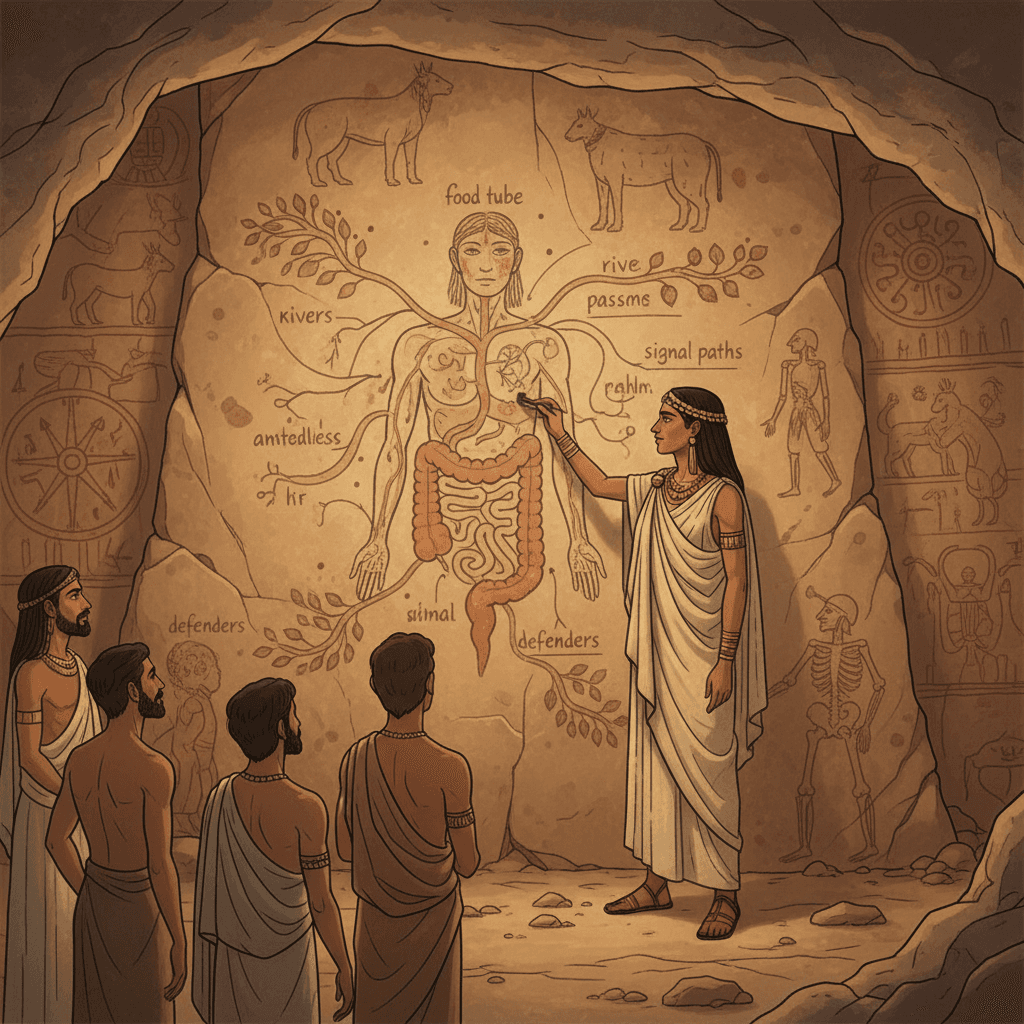
From the head — the commander's seat, protected by the hard dome of the skull — signal paths ran the length of the body. Orders down, messages up. Two controllers: the voluntary commander who made decisions, and the involuntary foreman who kept the essential machinery running whether the commander paid attention or not.
And running through it all, invisible and uncharted, a system of defenders. They fought with heat and swelling. They remembered what they fought, keeping wanted posters of old enemies so they could respond instantly if the same attacker returned.
Grujla held up her hand with its three numb fingers. "And when the signal paths are damaged, the messages stop. You deduced that from my hand."
"Your hand taught me more than most of my experiments," Crivsola said.
The Connections
Every system depended on every other. The food tube fed the rivers. The rivers fed the muscles, the frame, the head. The air fed the invisible fire that released the food's energy. The signals coordinated everything. The defenders protected it all.
"Each System is Separate" — the way she had studied them, one at a time — was a necessary fiction. In reality, none of them worked alone. Damage one, and the others followed. The body was not a collection of parts. It was a single system that happened to have distinguishable aspects.
The Letter
Tszuvok had brought something with him — a folded paper, carried from the prison by a guard who owed him a favour. A letter from Lomytguya.
Crivsola unfolded it and read aloud.
"You studied the body like a sealed clock. You could not open it. You could not see the gears. You listened to the ticking and you watched the hands move and you deduced what you could. Some of your models are wrong — you know this. You have always known this. But the most important thing you proved is not that the body has a pump or that air feeds an invisible fire. The most important thing you proved is that you can figure things out from the outside at all. That the clock does not need to be opened to be understood — partially, imperfectly, but genuinely. That is the thing worth keeping."
The room was quiet.
The Finished Picture
Crivsola stepped back from the wall. The drawing was dense — lines connecting systems, arrows showing flows, question marks where she was uncertain. There were many question marks.
"This is the best picture I can draw without opening the clock," she said. "Some of it is certainly wrong. But it is less wrong than the dreams of old Sudgara."
Brekvi raised his cup. Tszuvok nodded. Grujla flexed her two good fingers.
It was incomplete. It would always be incomplete — there were things inside the body that no amount of external observation could reveal, details that would require someone, someday, to open the clock.
But incomplete was not the same as worthless. A map with blank spaces was still a map. It told you where the rivers ran, even if it could not tell you what lived at the bottom of them.
She folded Lomytguya's letter and placed it on her desk. Then she picked up her pen, found an empty corner of the wall, and wrote a new question — the first question of whatever came next.