
Part 4 of 18
The Update
By Madhav Kaushish · Ages 12+
The following weekend, Glagalbagal arrived for dinner as promised. Vilila had purchased limes and arranged them on a plate with the same enthusiasm one might reserve for arranging furniture before a house fire.
Vilila: Finally. Please take your cousin off my hands. He has been talking about murder all week. I am beginning to worry about him.
Wrinje: I have not been talking about murder all week.
Vilila: You asked the postman whether he thought Jansu did it.
Wrinje: He delivers to the neighbourhood. He might know something.
Vilila: He delivers letters, Wrinje. He is not an informant.
Glagalbagal sat down at the table and began peeling a lime. She ate them the way most people eat oranges, which Wrinje still found disturbing.
Glagalbagal: Did you think about the question I left you with?
Wrinje: Yes. You asked whether the fact that the police arrested Jansu, and that she was the last person to see Glerna, changes the probability that she did it.
Glagalbagal: And?
Wrinje: Obviously it does. Both of those things make her look more guilty.
Glagalbagal: You are half right. But I want you to think about whether those two pieces of information are equally strong.
Wrinje: What do you mean?
Glagalbagal: Let us start with the arrest. Why did the police arrest Jansu?
Wrinje: Because she is the niece and she was the last person to see Glerna alive.
Glagalbagal: So the arrest is based on the other piece of evidence. The police did not find a weapon with her name on it. They did not catch her in the act. They arrested her because she was the last known visitor. The arrest itself does not give us any new information beyond what we already had.
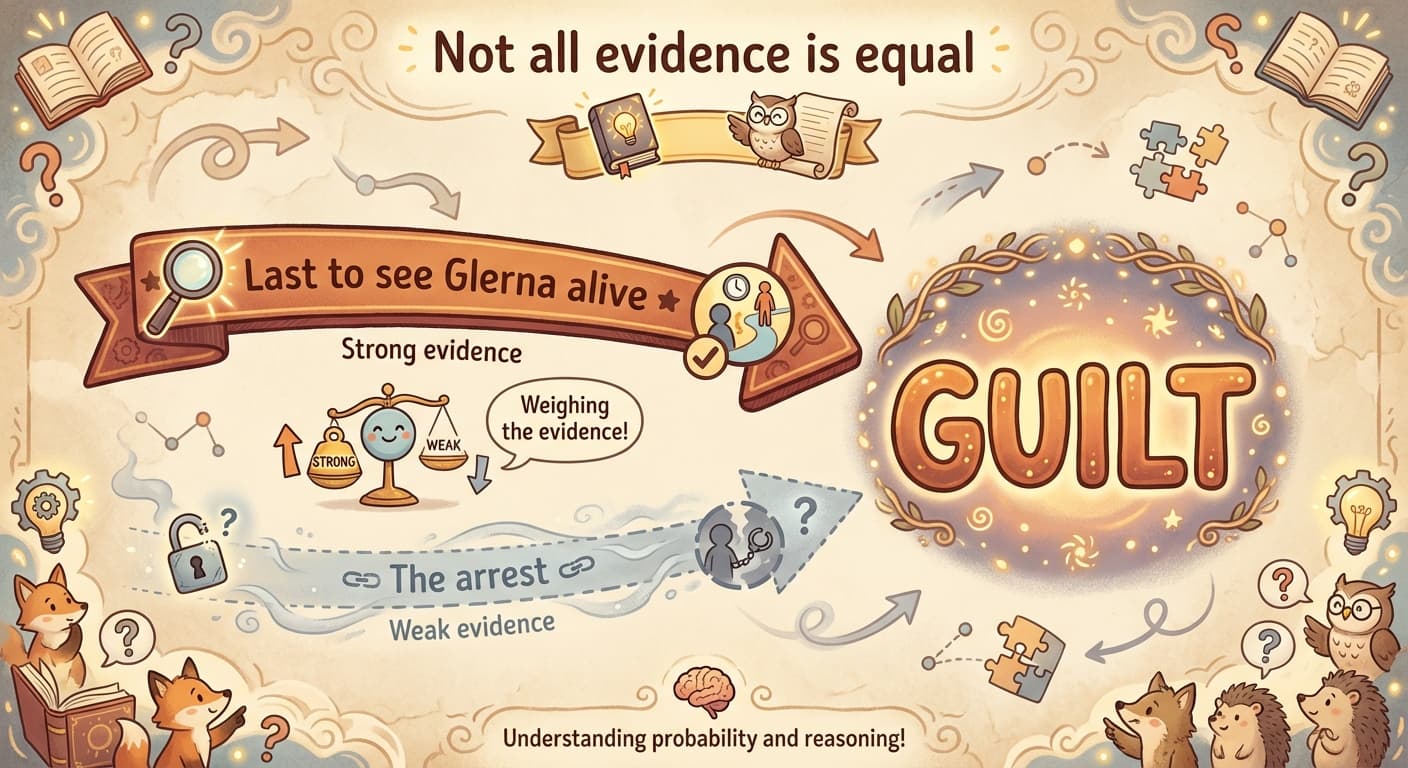
Wrinje: That is an interesting point. If I already know she was the last visitor, then hearing she was arrested does not tell me much more.
Glagalbagal: Exactly. Now think about the other piece — she was the last person known to have seen Glerna alive. How does that change things?
Wrinje: Well, the murder must have happened after the last time anyone saw Glerna alive. And Jansu was there. So she had the opportunity.
Glagalbagal: Good. Now, does that mean she definitely did it?
Wrinje: No. She says she left at 5pm. The murder could have happened after that. Someone else could have come to the house later.
Glagalbagal: Right. So what does this evidence actually do?
Wrinje: It puts Jansu in the house near the time of the murder. That makes it more likely she did it than we thought before, but it does not prove it.
Glagalbagal: Now here is the key question. Remember last week we calculated that the probability of Jansu being the killer was about 0.2%, based only on the fact that she knew Glerna. How much does this new information change that number?
Wrinje: A lot? She was right there.
Glagalbagal: Think more carefully. Being the last known visitor makes it more likely, yes. But "more likely" could mean going from 0.2% to 0.5%, or it could mean going from 0.2% to 50%. The question is: how much more likely is it that she was the last visitor if she is the killer versus if she is innocent?
Wrinje: If she is the killer, it makes sense that she was the last visitor — she would have been there to commit the murder. So that is very likely.
Glagalbagal: And if she is innocent?
Wrinje: She could still have been the last visitor. She is the niece. She probably visits regularly.
Glagalbagal: So it is not that surprising either way. If she were a stranger who had never visited Glerna before and was found to be the last visitor, that would be much stronger evidence. But a niece visiting her aunt is ordinary. The evidence points toward guilt, but not as strongly as it first appears.
Wrinje: So the arrest tells us almost nothing new, and being the last visitor tells us something, but not as much as I thought.
Glagalbagal: That is the lesson. Not all evidence is created equal. Some evidence barely shifts the probability. Other evidence can flip it entirely. The question you should always ask is: how much more likely is this evidence if the person is guilty compared to if they are innocent? If the answer is "about equally likely either way," the evidence is weak. If the answer is "much more likely if guilty," the evidence is strong.
Wrinje: I think I understand. But I still want to know who actually did it.
Glagalbagal: Then you need more evidence. What else do you know?
Wrinje: Nothing yet. But I have been reading the newspaper every day.
Vilila: He really has. It is the most reading he has done voluntarily in his life. Apparently all it takes is a dead body.