
Part 56 of 58
The Request
By Madhav Kaushish · Ages 12+
GlagalCloud's systems could classify, predict, answer questions, and reason through complex problems. But a new customer brought a request that none of these capabilities could address.
The Designer
Kvrothja — the farmer who had originally brought the blight detection problem — returned with a different need.
Kvrothja: I am expanding into hill terrain. I need new grazing layouts optimized for slopes — where to place water troughs, feeding stations, fences, and shelter. I have thirty existing hill-terrain layouts from other farms. Some work well, some do not. I need your system to design new layouts that combine the best features of the good ones.
Trviksha: I can train a model to evaluate layouts — given a layout, predict whether it will be productive. That is classification.
Kvrothja: I do not need evaluation. I need creation. I need the system to produce new layouts that I have never seen before. Not to judge existing designs — to generate new ones.
The Asymmetry
Trviksha had trained many models that could evaluate: is this patient sick, is this store contaminated, is this field blighted, is this summary helpful? In each case, the model took an input and produced a judgment. But creating a new layout was fundamentally different from evaluating an existing one.
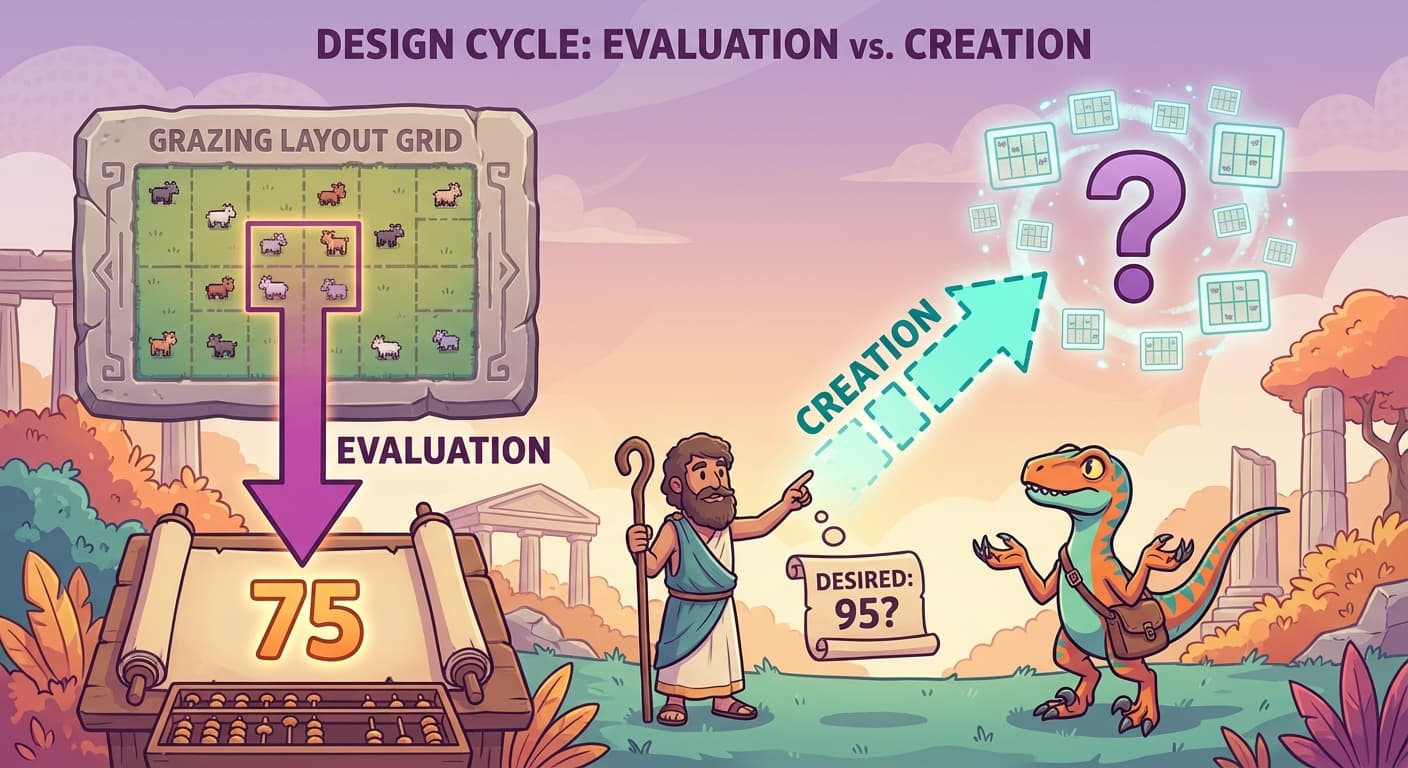
Trviksha: I can build a model that takes a layout as input and predicts its productivity score. I can even rank Kvrothja's thirty layouts from best to worst. But I cannot reverse the process — I cannot start from a desired score and produce a layout that achieves it.
Blortz: Evaluation goes from layout to score. Creation goes from score to layout. One direction is easy. The other is hard. Why?
Trviksha: Because there is one correct score for each layout, but millions of possible layouts for each score. Given a layout, the answer is a single number. Given a desired number, the answer is an enormous space of possibilities. The model does not know how to navigate that space.
Glagalbagal: A critic is not a creator. Knowing that a meal is good does not mean you can cook it. Knowing that a poem is beautiful does not mean you can write one.
The Generation Problem
Trviksha considered the options. The language model could generate text — and text generation was a form of creation. Could she represent layouts as text and have the language model generate new ones?
She tried it. She encoded Kvrothja's thirty layouts as sequences of tokens — grid positions, terrain types, infrastructure placements — and asked the language model to generate new layout sequences.
The results were syntactically valid — the generated sequences followed the format of real layouts. But they were not good layouts. The model had learned the format from thirty examples but did not have enough data to learn what made a layout productive. It generated plausible-looking arrangements that placed water troughs on hilltops, fences across feeding paths, and shelters in flood zones.
Kvrothja: These are not designs. They are random arrangements in the right format. My experienced farm hands would do better by intuition.
Trviksha: The language model was trained on text, not on layout design. Thirty examples is not nearly enough for it to learn spatial optimisation. I need a different approach — one specifically designed for generation, not adapted from a system designed for language.
She needed a method that could learn the structure of "good layouts" from examples and then produce new examples that shared that structure. Not by evaluation and reversal. Not by text generation. A fundamentally different approach to creation.