
Part 7 of 58
The First Velociraptor
By Madhav Kaushish · Ages 12+
Until now, the prediction process had been a sequence of steps performed by multiple velociraptors: one to read the inputs, one to multiply by weights, one to sum, one to compare against the threshold. Trviksha wanted to consolidate.
One Velociraptor, One Decision
She assigned the entire job to Drysska.
Trviksha: Here is your instruction tablet. Step one: read the patient's ten factor values from the input baskets. Step two: multiply each factor by its weight from the weight shelf. Step three: sum all the products. Step four: if the sum exceeds 40, place a black pebble in the output basket. If not, place a white pebble.
Drysska: Understood. Ten inputs. One output.
Trviksha: You are now the prediction system. Everything — the inputs, the weights, the sum, the decision — happens at your station.
Drysska set up her workstation. Ten input baskets on the left, each receiving a pebble arrangement representing one patient factor. A weight shelf in the middle, with ten stored weight arrangements. One output basket on the right.
For each patient, Drysska read the inputs, multiplied, summed, compared, and placed a pebble. Black or white. Examine or wait. The entire prediction system was one velociraptor at one workstation.
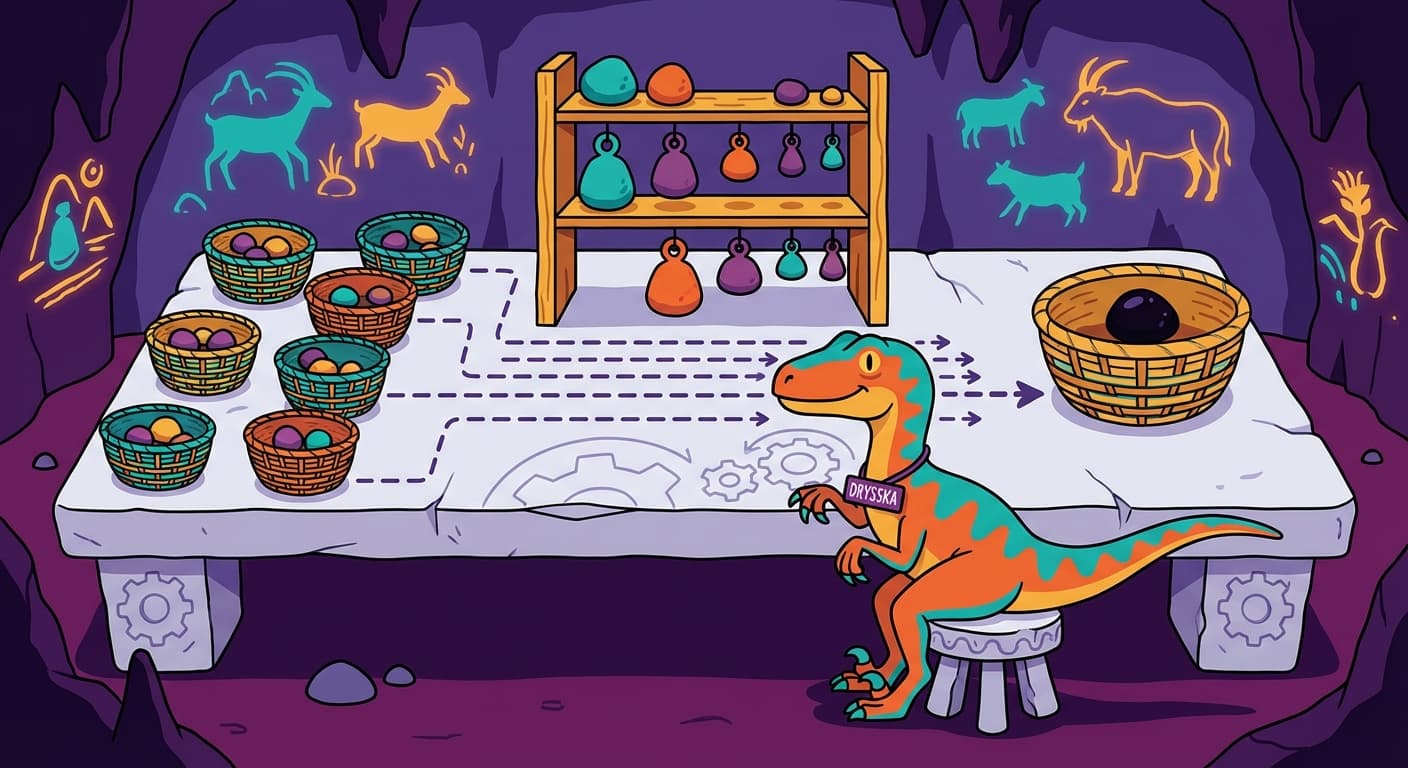
Trviksha: Drysska, you are a decision machine. You take numbers in and put a decision out.
Drysska: I do not decide anything. I compute a sum and compare it to a number. The pebble placement follows.
Trviksha: That is what deciding means, when you are a velociraptor.
The Cliff
Grothvik sent patients through the system. For most, it worked well. But she noticed something uncomfortable.
Grothvik: Patient 247 scored 39.8. White pebble — wait. Patient 248 scored 40.3. Black pebble — examine immediately. These two patients are almost identical in risk. But one gets my attention today and the other does not.
Trviksha: The threshold is at 40. One is below, the other above.
Grothvik: The difference between 39.8 and 40.3 is meaningless. It is noise in the data, rounding in the computation. But the output treats them as categorically different. Could the output be softer? Not yes-or-no, but something in between?
Trviksha considered this. The hard cutoff was a cliff: below 40, nothing; above 40, everything. Patients near the edge were treated identically to patients far from it, just on opposite sides.
The Slope
Trviksha: What if Drysska's output were not black-or-white but a shade? Scores far above the threshold produce a very dark pebble — high urgency. Scores far below produce a very light pebble — low urgency. Scores near the threshold produce a grey pebble — moderate urgency.
Blortz: You are replacing a cliff with a hill. The decision is still there, but now it slopes.
In practice, Trviksha encoded the output as a number between 0 and 1. She defined a smooth curve — steep in the middle, flat at the extremes — that mapped any sum to this range. Sums far below the threshold mapped to values near 0. Sums far above mapped to values near 1. Sums near the threshold mapped to values near 0.5.
Trviksha: The curve is the rule for how the sum becomes an output. Different curves give different behaviors. A cliff — the hard cutoff — is one rule. A smooth slope is another. The choice affects how the system communicates uncertainty.
The hard cutoff said: "yes or no, nothing in between." The smooth curve said: "probably no, maybe, probably yes, almost certainly yes." The smooth version was more informative. It told Grothvik not just the decision but the confidence behind it.
Triage
Grothvik adopted the smooth output as a triage tool. Patients scoring above 0.8 were examined immediately. Patients between 0.5 and 0.8 were scheduled within the week. Patients below 0.5 were monitored at their next routine visit. The graduated output gave her three tiers of urgency instead of two.
Glagalbagal: One velociraptor does the work of a healer's intuition?
Trviksha: One velociraptor does a crude approximation of one narrow aspect of a healer's intuition. Do not overstate it.
Glagalbagal: I am not overstating it. I am marvelling at it.
Trviksha: Marvel quietly. I have a problem. Drysska handles the cases where the pattern is simple — where a single weighted sum captures the risk. But some patterns are not that simple. Jvelthra the agricultural inspector has been waiting for three weeks, and her problem is one that Drysska, no matter how I adjust the weights, cannot solve.