
Part 8 of 58
The Impossible Line
By Madhav Kaushish · Ages 12+
Jvelthra was an agricultural inspector responsible for grain stores across twelve villages. Mould and fungal contamination were destroying stockpiles, and she needed to predict which stores were at risk. She had records of two hundred and thirty grain stores, with two key factors: humidity level and temperature.
The Easy Problem
Trviksha started with Jvelthra's first dataset: mould contamination. She plotted the data on a stone grid — humidity along one axis, temperature along the other. Each grain store was a pebble: black for mouldy, white for clean.
The pattern was straightforward. High humidity and high temperature together produced mould. Low humidity or low temperature (or both) did not. The black pebbles clustered in one corner. The white pebbles filled the rest.
A single perceptron — Drysska, with two inputs and a threshold — drew a line across the grid. On one side: predict mould. On the other: predict clean. After training, the perceptron achieved 91% accuracy. The line separated the clusters neatly.
Trviksha: One line, two factors, clean separation. This is the kind of problem Drysska was built for.
Then Jvelthra brought a second dataset.
The Strange Pattern
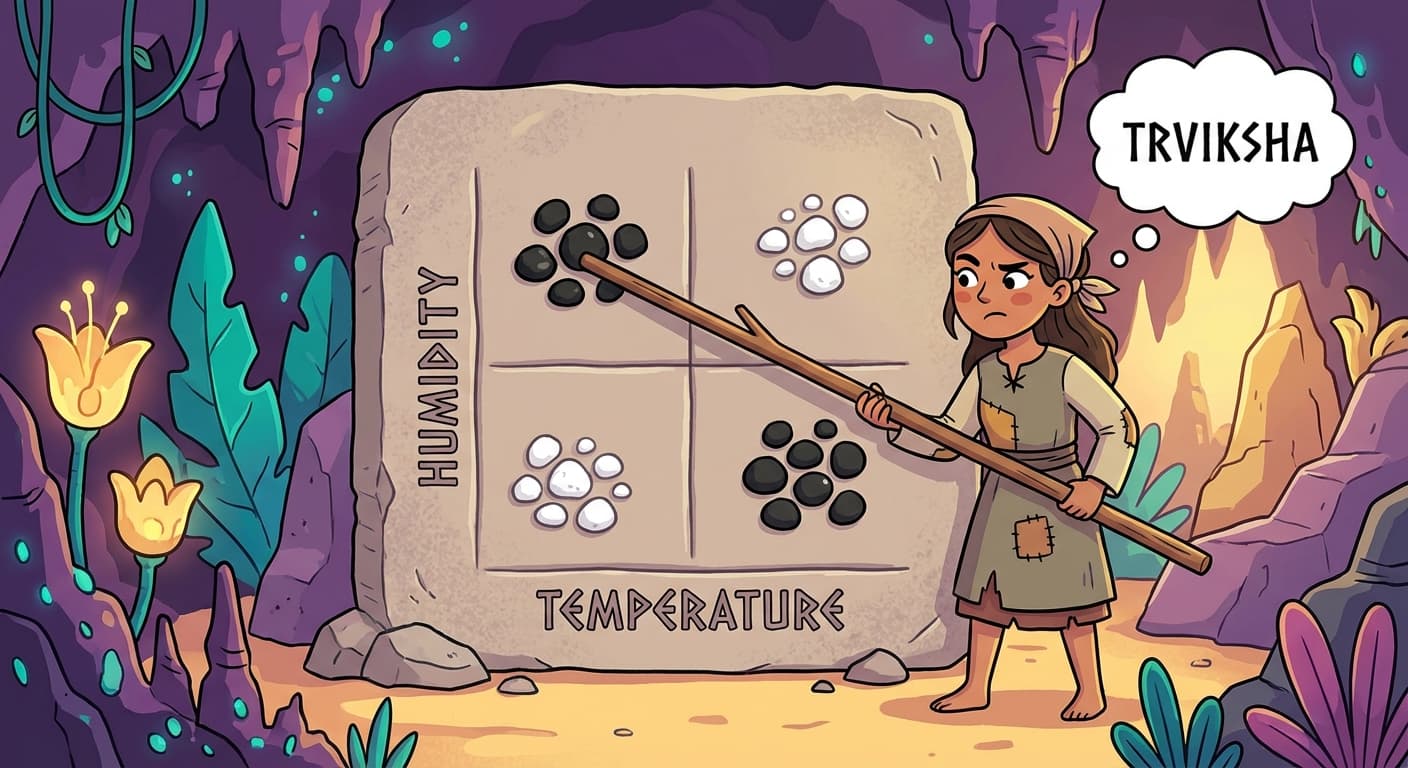
This contamination was different — a fungus that behaved oddly. It attacked grain stores that were either hot-and-dry or cold-and-wet. Stores that were hot-and-wet were fine (the heat killed the fungus when moisture was present). Stores that were cold-and-dry were also fine (the fungus needed some moisture to activate in cold conditions).
Trviksha plotted the data. Black pebbles clustered in two opposite corners: upper-left (cold, wet) and lower-right (hot, dry). White pebbles clustered in the other two corners: upper-right (hot, wet) and lower-left (cold, dry).
She tried to place a line separating black from white. She could not. Any line that captured the upper-left cluster also swept in either the upper-right or lower-left white cluster. The contaminated stores were not on one side of any line. They were on opposite corners.
The Systematic Failure
Trviksha ran the weight adjustment anyway. Perhaps she was wrong about what was possible, and the numbers would find a solution her eyes had missed.
The perceptron settled on weights that produced 51% accuracy — essentially random. No matter how many passes she ran, no matter how she started the weights, the perceptron could not do better than a coin flip on this data.
Trviksha: I tried every starting position. I ran the adjustment hundreds of times. It cannot solve this.
Drysska: That is because you are asking me to do something that cannot be done with the tools I have. I compute a sum and compare it to a threshold. The answer is not a sum-and-threshold kind of answer.
Trviksha: Since when do you have opinions about what kind of answer things are?
Drysska: I do not have opinions. I have operational constraints.
The failure was not a matter of insufficient training or bad starting weights. It was structural. A perceptron partitioned the input space with a single straight line. If the true boundary between the classes was not a straight line — if the classes were tangled in a way that no single cut could untangle — then no set of weights would work. Not because the right weights had not been found, but because the right weights did not exist.
The Name
Blortz, who had been watching the stone grid, offered a characterisation.
Blortz: The mould problem is linearly separable. You can separate the two groups with a straight line. The fungus problem is not linearly separable. The groups are tangled in a way that no straight line can untangle.
Trviksha: Can anything untangle them?
Blortz: Two lines could. One line to isolate the cold-wet corner. Another to isolate the hot-dry corner. A store is at risk if it is on the flagged side of either line.
Trviksha: But Drysska draws one line. That is all she can do. One weighted sum, one threshold, one boundary.
Jvelthra: So your system cannot solve my problem?
Trviksha: This system cannot. I need a different system. One that can draw more than one line.
Jvelthra: How different?
Trviksha: More velociraptors.