
Part 11 of 43
The Sieve
By Madhav Kaushish · Ages 12+
The prison served porridge twice a day, and it was always lumpy. Dvushak, whatever his other qualities, was not a skilled cook. Some prisoners had taken to straining their porridge through a piece of cloth to remove the worst of the lumps, drinking only the liquid that passed through.
Crivsola watched this process with great interest.
The Straining Cloth
The cloth allowed small particles and liquid to pass through while trapping the larger lumps on one side. The result was a separation — useful material on one side, unwanted material on the other.
The walls of the food tube must work the same way.
The dissolving liquid broke food down into very small particles — a liquid mush, like Dvushak's overnight porridge. The useful parts of this dissolved food needed to pass through the walls of the tube and into the body. The waste — the parts the body could not use — needed to continue down the tube and exit normally.
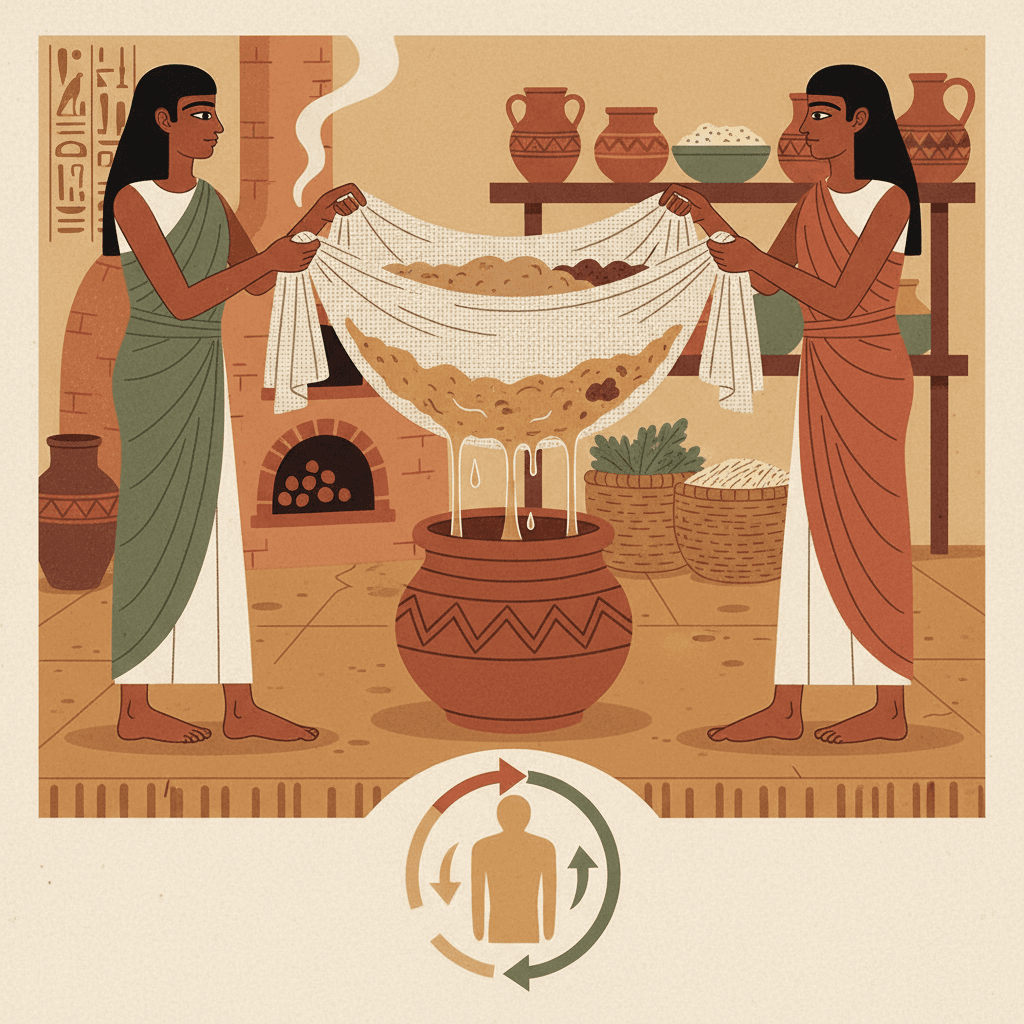
The walls of the tube, Crivsola reasoned, must be a kind of sieve. They must contain tiny openings — far too small to see — that allowed dissolved food to leak through while keeping waste inside the tube.
The Goldilocks Problem
But this model had a constraint that Crivsola found troubling. The openings could not be too large or too small.
If the openings were too large, everything would leak through — including waste. The body would absorb material it could not use, and nothing would exit the tube as waste. This did not match observation. Waste was produced regularly.
If the openings were too small, nothing useful would pass through. All the dissolved food would simply travel the length of the tube and be expelled as waste. The body would get no benefit from eating. People would starve despite eating constantly.
The openings must be exactly the right size — large enough to let useful material through, small enough to keep waste in.
This was a tight constraint. It meant the sieve could not be a crude filter. It had to be precise.
The Simple Strainer — and Its Limits
Crivsola's model was a simple strainer — a passive sieve with fixed holes that separated material by size alone. She had no way of knowing that the real process was far more complex. The walls of the actual digestive tract do not merely let things leak through — they actively select and transport specific molecules, using mechanisms she could not have imagined.
But the strainer model captured the essential idea: the tube's walls were permeable in a controlled way, allowing useful material to cross while retaining waste. It was wrong in its details and right in its principle.
Where Does It Go?
The useful material leaked through the walls of the tube. But then what? It was now outside the tube and — somewhere inside the body. It needed to reach every part of the body. The muscles, the bones, the skin, the brain. Every part of the body needed food, or it would wither.
How did dissolved food travel from a tube in the midsection to the tips of the fingers and the soles of the feet?
Crivsola had a hunch. But she would need Lomytguya's help to think it through.