
Part 12 of 43
The River Inside
By Madhav Kaushish · Ages 12+
From the narrow window of their cell, Crivsola and Lomytguya could see the prison's vegetable garden — and beyond it, the network of irrigation channels that fed the fields outside the prison walls. Water from the central well was directed through a main channel, which branched into smaller channels, which branched again into tiny furrows running between individual rows of crops.
Every plant in the field received water. Not because each plant was next to the well, but because the branching channels delivered water everywhere it was needed.
The Prediction
Crivsola had established that dissolved food passed through the walls of the food tube. But the tube ran through only a small portion of the body — roughly the midsection. The rest of the body — the arms, legs, head, fingers, toes — was far from the tube. Yet every part of the body clearly received nourishment. A person who stopped eating grew thin everywhere, not just near the tube.
The body must contain a network of channels — like irrigation rivers — that carry dissolved food from the tube to every part of the body.
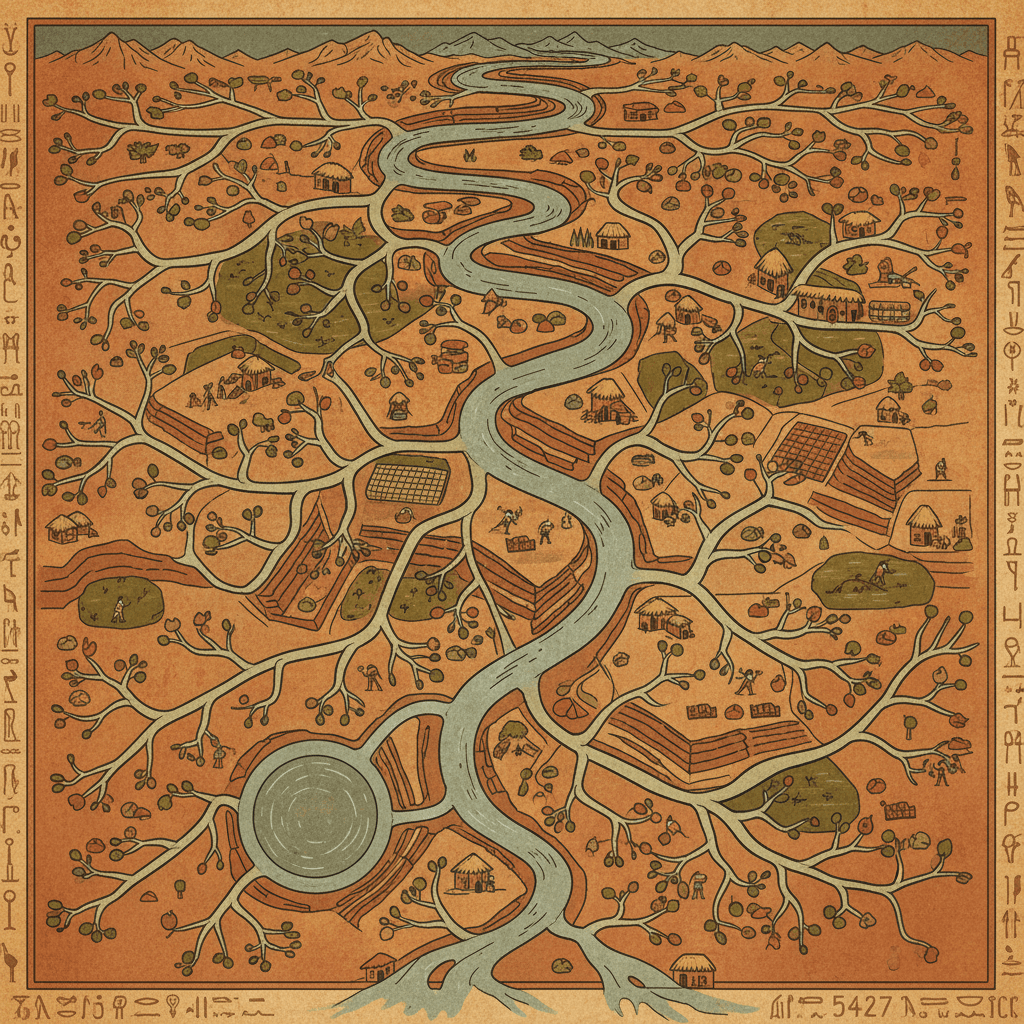
This was not an observation. Crivsola had never seen these channels. She was not deducing their existence from something she had noticed. She was predicting that they must exist because her model required them.
Theoretical Prediction
This was a different kind of reasoning from anything she had done before. Previously, she had observed something — food not coming out during a headstand, the body not gaining weight — and built a model to explain it. Now she was going in the other direction. She had a model, and the model demanded that something exist.
If food is dissolved in the tube, and if the dissolved food passes through the tube walls, and if every part of the body needs food, then there must be channels carrying that food everywhere.
The channels were a prediction of her theory. She had not seen them. But if her model was correct, they had to be there.
Supporting Evidence
Lomytguya pointed out two observations that supported the prediction, though neither was conclusive.
First: when a person was cut, they bled. Blood — a liquid — flowed from inside the body. This suggested there were channels carrying liquid inside the body. Whether these were the same channels that carried dissolved food, Crivsola could not say. But the existence of internal liquid channels was at least consistent with her prediction.
Second: a person's skin was warm everywhere — fingertips, earlobes, the tops of the feet. Warmth had to come from somewhere. If internal channels carried warm liquid throughout the body, it would explain why the entire surface felt warm.
Rumblings
There was talk among the prisoners of a coming amnesty. The governor of Sonhlagot, it was said, had been embarrassed by a foreign dignitary's remark about the number of people imprisoned for "bodily offenses" — headstands, public sneezing, left-handed waving, and other violations of Sonhlagot's extensive physical conduct laws.
Lomytguya was skeptical. "They never pardon political prisoners," she said. "Union organising is not a bodily offense. It is an ideological one."
Crivsola said nothing. She was thinking about rivers inside the body. But a small part of her mind was thinking about freedom.