
Part 14 of 43
The Architecture of Standing
By Madhav Kaushish · Ages 12+
Crivsola stepped out of the Sonhlagot Central Penitentiary on a cool morning, blinking at a sky she had not seen without bars across it in quite some time. Tszuvok was waiting for her by the gate, holding a bag of fresh bread — a gesture of welcome, and also, she suspected, an excuse to ask more questions.
A New Question
They walked through the market district, and Crivsola found herself looking at bodies differently. Not at what went into them or came out of them, but at their shape. The food model — tube, dissolving liquid, sieve-walls, internal rivers — was as complete as she could make it from the outside. It was time for something new.
What gives the body its shape?
A person stood upright. They kept their form whether sitting, standing, or lying down. A corpse retained its shape for some time after death. Something structural was holding everything in place.
The Clay Pot Model
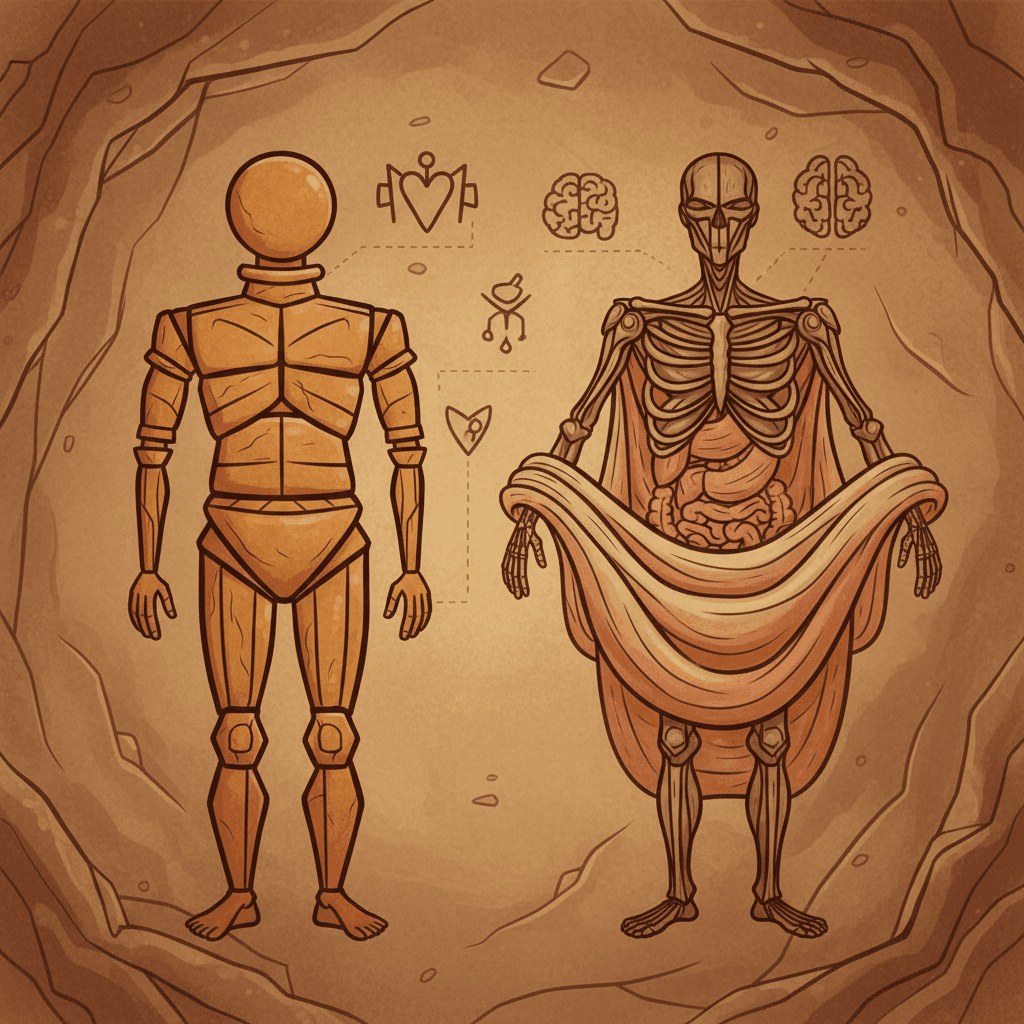
"Consider a clay pot," Crivsola said to Tszuvok as they sat on a bench near the tannery. "It holds its shape because the material itself is rigid. Perhaps the human body is the same — the Clay Pot model. The entire body is made of firm material, and that is why it does not collapse into a heap."
Tszuvok nodded slowly. He was a carpenter by trade, and the idea of rigid material holding a shape made intuitive sense to him.
The Pinch Test
But Crivsola was already testing it. She pressed her thumb into the flesh of her forearm. It yielded — soft, pliant, squishing under pressure. She pressed harder. Beneath the softness, she felt something firm that did not give way.
"Press your arm," she told Tszuvok.
He did. His eyes widened. "It is soft on the outside. But there is something hard underneath."
"Now press the top of your head."
He reached up. "Hard. Right at the surface."
"Your stomach."
"Soft. Very soft."
The body was not uniformly rigid. Some areas squished easily. Others resisted. The Clay Pot model predicted that the body should feel the same everywhere — firm, like clay. It did not.
The Frame Model
The pattern was suggestive. Soft material on the outside, hard material hidden underneath — but not everywhere. The hardness seemed to be concentrated in certain places.
"What if the body is not rigid throughout," Crivsola said, "but has a rigid frame inside — like the timber frame of a house — with soft material draped and packed around it?"
Tszuvok understood this immediately. He built frames for a living. A house was not solid wood all the way through. It had a skeleton of beams, and the spaces between were filled with mud, straw, and plaster. The frame gave the structure its shape. Everything else just filled in the gaps.
The body has a hidden frame — hard where the frame is, soft where it is not.
This was a model she could investigate further. If the body truly had an internal frame, she should be able to map it — find every place where the hard structure lay close enough to the surface to feel. She would need to be systematic about it. And she would need more than one pair of hands.
She turned to Tszuvok. "Tomorrow, bring paper."