
Part 15 of 43
The Bump Map
By Madhav Kaushish · Ages 12+
Tszuvok arrived the next morning with paper, charcoal, and the earnest expression of a man who had been thinking about skeletons all night. Crivsola had already drawn an outline of the human body on a large sheet.
The Method
The plan was simple. Start at the top of the head and work downward, pressing through the skin at every point, noting where the underlying material was hard and where it was soft. Mark the hard spots on the drawing. By the end, they would have a map of the hidden frame.
Crivsola went first, pressing along her own body systematically — scalp, face, neck, shoulders, arms, torso, hips, legs, feet. Tszuvok recorded her findings on the outline.
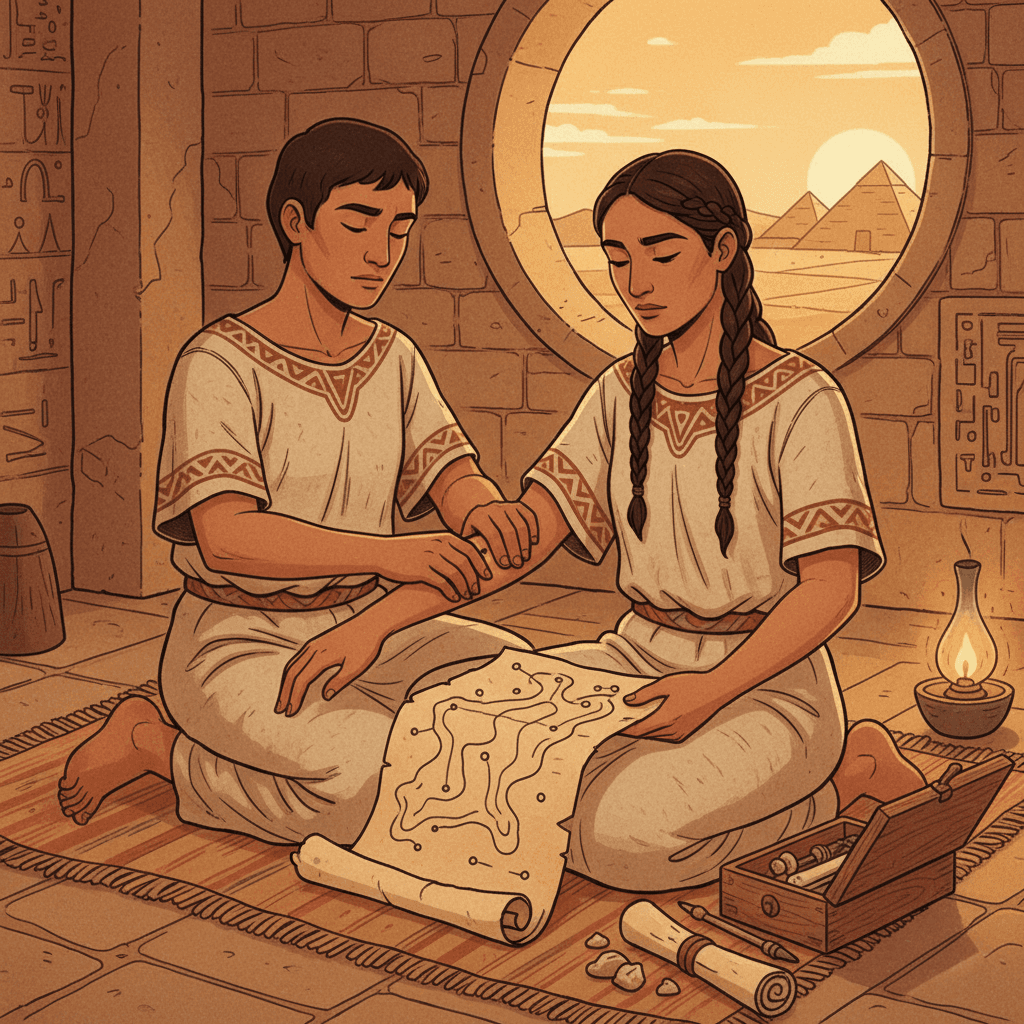
The Findings
The map that emerged was remarkable. The top of the head was hard — a dome of rigid material encasing whatever lay inside the skull. The face had hard ridges around the eyes and along the jaw. Down the front of the neck, she found a hard lump. The collarbones ran like two horizontal bars beneath the shoulders. The chest had a flat plate down the centre with curved bars sweeping around each side.
Down the back, a long ridge of bumps ran from the base of the skull to the hips — like a chain of small stones stacked on top of one another. The arms had long hard rods running through them, one in the upper arm and two in the lower. The legs were similar — a single thick rod in the thigh, two thinner ones below the knee. The kneecap sat like a shield over the front of the joint.
Even the hands had hard structures — tiny rods running through each finger.
Two Maps
Then Tszuvok mapped his own body while Crivsola recorded. When they compared the two maps, the results were nearly identical. Hard spots in the same places, ridges and rods following the same patterns.
There were small differences. Tszuvok's jaw was broader. Crivsola's wrists were narrower. But the overall architecture — the layout of the frame — was the same in both bodies.
"This is important," Crivsola said. "If I had only mapped myself, I might worry that my body was unusual. But we both have the same frame in the same arrangement. It is likely that all humans do."
The Shape of the Frame
Crivsola studied the completed map. The frame was not a single solid piece. It was a collection of many separate hard structures — rods, plates, domes, small stacked bumps — connected to each other in a specific arrangement.
The body's frame is not one piece but many, fitted together like the timbers of a house.
"In carpentry," Tszuvok said, studying the map with professional interest, "every joint between two beams is a potential weakness. But it is also where the structure can flex. A house made of one solid piece of wood would be strong but could not adjust to anything."
Crivsola looked at the places where one hard structure ended and the next began. The elbow. The knee. The shoulder. The wrist. These were exactly the places where the body bent.
"Not weaknesses," she said. "Hinges."
That raised an interesting question. If the connection points between frame pieces were what allowed the body to bend, then the type of connection would determine the type of bending. Were all the connection points the same?
She bent her elbow. She rolled her shoulder. The answer was obviously no.