
Part 16 of 43
Hinges and Swivels
By Madhav Kaushish · Ages 12+
Crivsola began with the assumption that all bending-points in the body worked the same way. This seemed reasonable. If the frame was built from similar materials, why would the joints be different?
She was wrong.
The Elbow
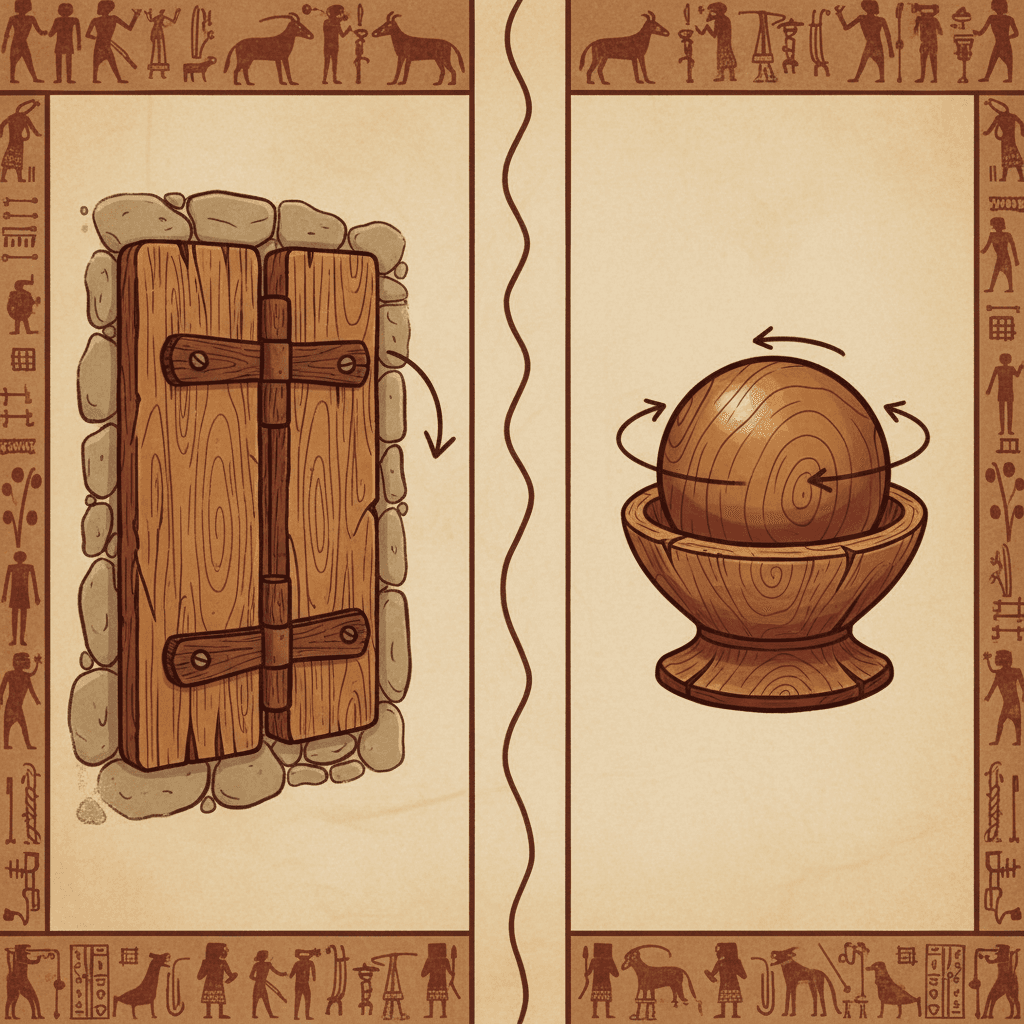
She started with the elbow, because it was easy to observe. Straighten the arm. Bend it. Straighten. Bend. The forearm swung toward the upper arm along a single line, then swung back. It could not swing sideways, or twist at the elbow, or rotate in a circle. It moved in exactly one direction, like a door on a hinge.
"Your trade," she said to Tszuvok. "What does this remind you of?"
"A door hinge," he said without hesitation. "One piece rotates against the other, but only in one plane. I install dozens of them every month."
Crivsola called this the door-hinge joint. Two hard frame-pieces meeting at a point, with motion restricted to a single back-and-forth arc. The knee worked the same way — the lower leg swung forward and back, but did not rotate or swing to the side.
The Shoulder
Then Crivsola moved to the shoulder, expecting the same thing. She raised her arm forward. Back. To the side. She rotated it in a full circle. She twisted it inward and outward.
This was not a door hinge.
The shoulder allowed movement in nearly every direction — forward, backward, sideways, and in rotation. No single-axis hinge could do this. Whatever was happening at the shoulder was fundamentally different from what was happening at the elbow.
The Ball in the Cup
Tszuvok was the one who found the analogy. "I have seen something like this," he said, cupping one hand and placing his fist inside it. "A round knob sitting in a hollow. The knob can rotate freely in any direction because the cup holds it in place but does not restrict which way it turns."
Crivsola stared at his hands. "A ball in a cup."
"Exactly. The hip works the same way — I can swing my leg in a circle."
She tested it. He was right. The hip, like the shoulder, allowed multi-directional movement. The ball-in-cup joint was a second type — fundamentally different from the door-hinge.
A Family of Joints
As they worked through the body, more varieties appeared. The wrist could bend forward, backward, and side to side, but did not rotate as freely as the shoulder — something in between. The base of the thumb had its own peculiar range. The spine — that chain of stacked bumps — seemed to have tiny amounts of movement between each bump, adding up to the large bends of the back.
The body uses different types of connection depending on what kind of movement is needed at each point.
This was an elegant insight. The frame was not assembled with one uniform joint. It was engineered — each connection designed for a specific purpose. Door-hinges where the body needed simple folding. Ball-in-cup joints where it needed full rotation. And other types in between.
Tszuvok nodded approvingly. "A good carpenter does the same thing. You do not use the same joint for a door and a wheel axle."
Crivsola now had a detailed picture: a frame of many hard pieces, connected by joints of varying types, covered in soft material. But this raised the most important question of all. The frame explained shape. The joints explained where the body could bend. But what actually made it bend? When Crivsola raised her arm, what was doing the raising?
Something was making the frame move. And it was not the frame itself.