
Part 27 of 43
The Air Question
By Madhav Kaushish · Ages 12+
Brekvi arrived at Crivsola's workshop wheezing. He was a glassblower — had been for twenty years — and lately the long hours at the furnace had left him short of breath. He sat on the bench with his hands on his knees, pulling air in through his mouth in slow, deliberate gulps.
"How long has this been happening?" Crivsola asked.
"Months. It is worse after a full day's work." He straightened up. "The other glassblowers say it is normal. I am not convinced."
The Obvious Fact
Crivsola treated his symptoms as best she could — rest, warm liquids, reduced hours at the furnace. But Brekvi's visit lodged something in her mind. She had spent months studying food and the red rivers. She had mapped the frame, traced the pump's circuit, predicted a cleaning station. And yet she had entirely neglected something so obvious that every living person did it without thinking.
People breathe. Constantly. Stop for more than a few minutes and you die.
This was at least as fundamental as eating. A person could survive days without food but only minutes without air. Whatever air did for the body, the body needed it desperately and continuously.
The Same Air?
The question was simple. Did the same air go in and come out?
Crivsola breathed in through her nose. Cool air, dry — the same as the air in the room. She breathed out through her mouth onto the back of her hand. The exhaled air was warm. Noticeably warm.
She tried again, breathing out slowly. The air leaving her body was warmer than the air entering it.
But warmth was only part of the change. She needed a better test.
The Polished Plate
Crivsola took a small piece of polished metal — a copper plate she used for mixing remedies — and held it near her face. She breathed in. Nothing happened to the plate. She held it close to her mouth and breathed out. A fine mist appeared on the surface, fogging the polished copper.
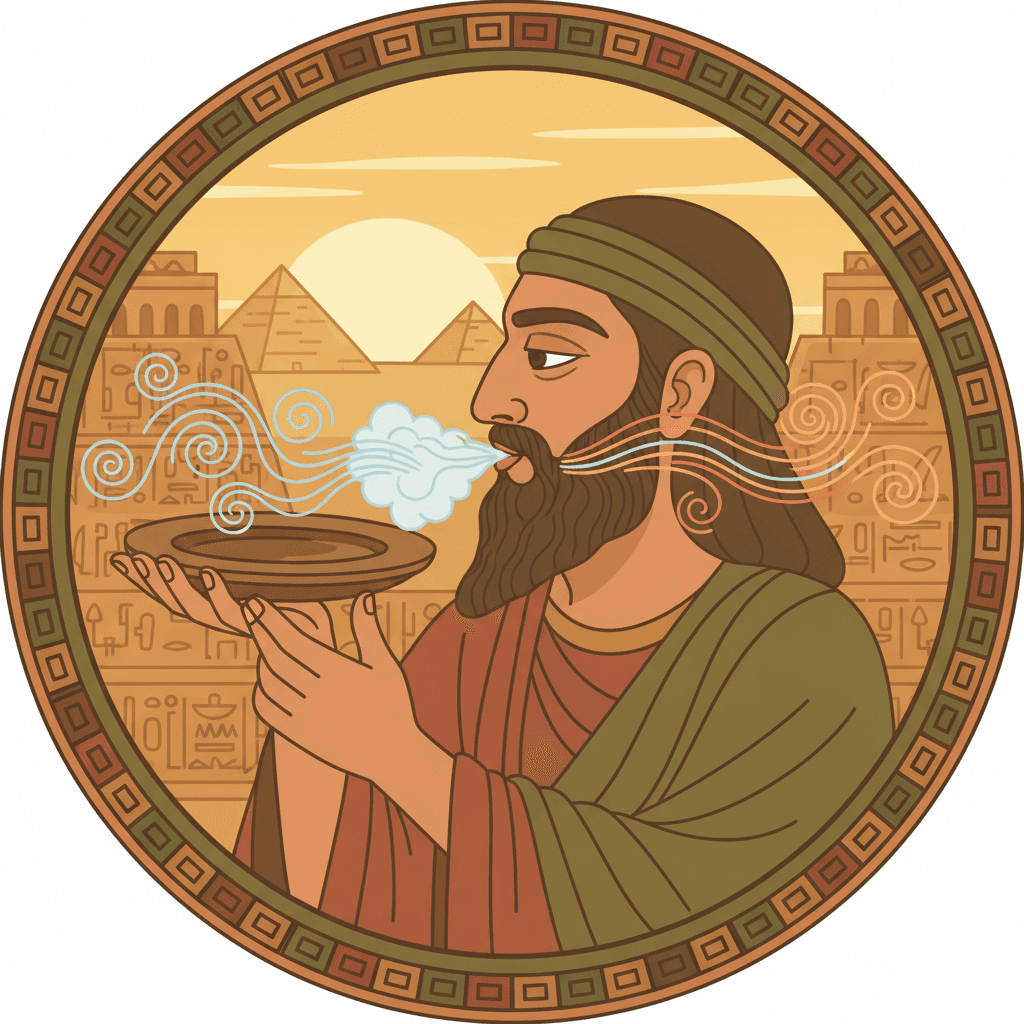
Air enters the body cool and dry. It leaves warm and wet.
The body was adding something to the air — at least warmth and moisture. And if something was being added, perhaps something was also being taken away. The air that left was not the same air that entered. It had been changed.
A Wrong Turn
Her first model came quickly. The body was warm — she had known this since the earliest days of her investigations. Perhaps breathing existed to regulate that warmth. A breeze cooled you down on a hot day. Maybe the body drew cool air in to prevent overheating — the Cooling Model.
But the evidence she had just collected contradicted this immediately. If breathing existed to cool the body, the air should leave cooler than it entered, having absorbed heat. Instead, the air left warmer. The body was heating the air, not the other way around.
Breathing was not about cooling. The body was doing something to the air — taking something from it, adding something to it — and Crivsola did not yet know what.
She mentioned this to Brekvi at his next visit. He listened carefully, then said: "You should watch a fire sometime. Really watch it. See what it needs and what it produces."
Crivsola was not sure what fires had to do with breathing. But Brekvi had spent his life with fire, and she had learned to take expertise seriously wherever she found it.