
Part 28 of 43
The Bellows
By Madhav Kaushish · Ages 12+
Brekvi brought a candle to his next appointment. He set it on Crivsola's workbench, lit it, and placed an upturned glass jar over it. The flame shrank, flickered, and died.
"Every glassblower learns this on the first day," he said. "Fire needs air. Cut off the air and the fire goes out. No matter how much fuel you give it."
Fire and Life
Crivsola stared at the dead candle under the jar. Fire needed air. People needed air. Fire without air died. People without air died.
This was not proof of anything. Two things could share a symptom without sharing a cause. But the parallel was striking enough to take seriously.
"What does fire need, exactly?" she asked.
Brekvi counted on his fingers. "Fuel — wood, wax, oil. Air. And something to start it — a spark. Give it fuel and air, and it burns. Take away either one, and it stops."
"And what does it produce?"
"Heat. Light. Smoke. Ash." He paused. "And the air around a fire feels wet sometimes. Damp."
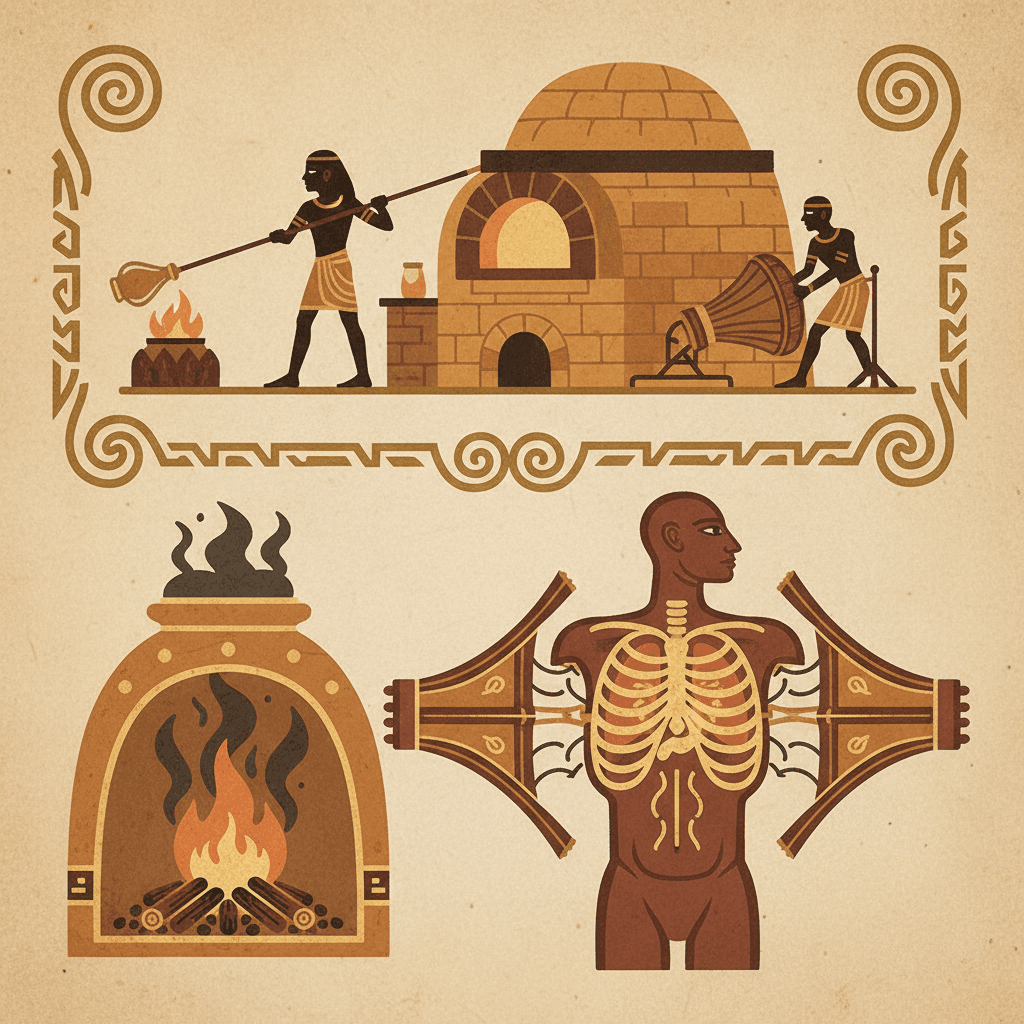
The Invisible Fire
Crivsola sat with this for a long time. The body needed food — that was the fuel. The body needed air. The body produced heat — it was warm, always warm, and a corpse grew cold. The body produced moisture — she had just demonstrated this with the polished plate.
Food plus air produces heat, moisture, and waste. Burning fuel plus air produces heat, moisture, and ash.
Perhaps the body contained something like a fire — not actual flames, nothing you could see or feel burning, but a process that worked on the same principle. Food was the fuel. Air provided whatever ingredient fire drew from it. And the result was the warmth and energy that kept the body alive.
She called this the Actual Fire model, knowing even as she named it that the details were wrong. There were no flames inside a person. You could press your hand to someone's stomach and feel warmth, but never the searing heat of a fire. Nobody produced smoke.
Right Principle, Wrong Details
And yet the analogy captured something real. The body needed both food and air — just as fire needed both fuel and air. Remove either one and the body died — just as fire went out. The body produced heat and moist waste — just as fire produced heat and damp smoke.
The Bellows
The analogy raised a mechanical question. Fire did not simply wait for air to drift toward it. In Brekvi's workshop, the furnace had bellows — a leather bag that pumped air into the flames in steady bursts. Without the bellows, the furnace burned weakly. With them, it roared.
Crivsola placed her hands on her own ribs. She breathed in. The ribs expanded outward, the chest rising. She breathed out. The ribs contracted, the chest falling.
In. Expand. Out. Contract. In. Expand. Out. Contract.
The chest is a bellows.
Something in the chest was pumping air in and out of the body, rhythmically, automatically — exactly the way bellows pumped air into a furnace. The body had built its own air pump, sitting right next to the chest-pump that drove the red rivers.
Two pumps in the chest. One for the red fluid. One for air. And both, apparently, essential to life.
Brekvi watched her pressing her ribs with an expression of mild concern. "Are you quite well?"
"Better than well," Crivsola said. "I think I know why you need to breathe."