
Part 6 of 18
The Lineup
By Madhav Kaushish · Ages 12+
Wrinje called Glagalbagal on the phone. He did not want to wait for the next dinner visit. Vilila complained that phone calls cost money, but Wrinje pointed out that they had not paid for a phone call since 2011, and Vilila told him not to be smart.
Wrinje: Glagalbagal, did you see the news about the eyewitness?
Glagalbagal: Hyjop the shopkeeper? Yes, I saw it.
Wrinje: He says he saw Jansu near Glerna's house at 7pm. She said she left at 5. That is very strong evidence, right?
Glagalbagal: It could be. But before you get too excited, let me ask you something. How reliable do you think eyewitnesses are?
Wrinje: I mean, he saw her. People generally know what they see.
Glagalbagal: Do they? There have been many studies on this. In the United States, over 70% of wrongful convictions that were later overturned by DNA evidence involved eyewitness misidentification.
Wrinje: Seventy percent?
Glagalbagal: Yes. Eyewitnesses are much less reliable than most people think. Let me give you a concrete number to work with. Suppose, based on the conditions that evening — the lighting, the distance, how briefly Hyjop saw the person — there is a 70% chance that his identification is correct. That means there is a 30% chance he is wrong.
Wrinje: Okay. But 70% is still pretty high. So there is a 70% chance Jansu was there, which means there is about a 70% chance she is guilty?
Glagalbagal: No. That is a mistake, and it is a very common one.
Wrinje: What do you mean?
Glagalbagal: The 70% is the probability that Hyjop correctly identifies the person he saw, given that it was actually Jansu. But you want to know the probability that it was actually Jansu, given that Hyjop identified her. Those are not the same thing.
Wrinje: How can they not be the same thing?
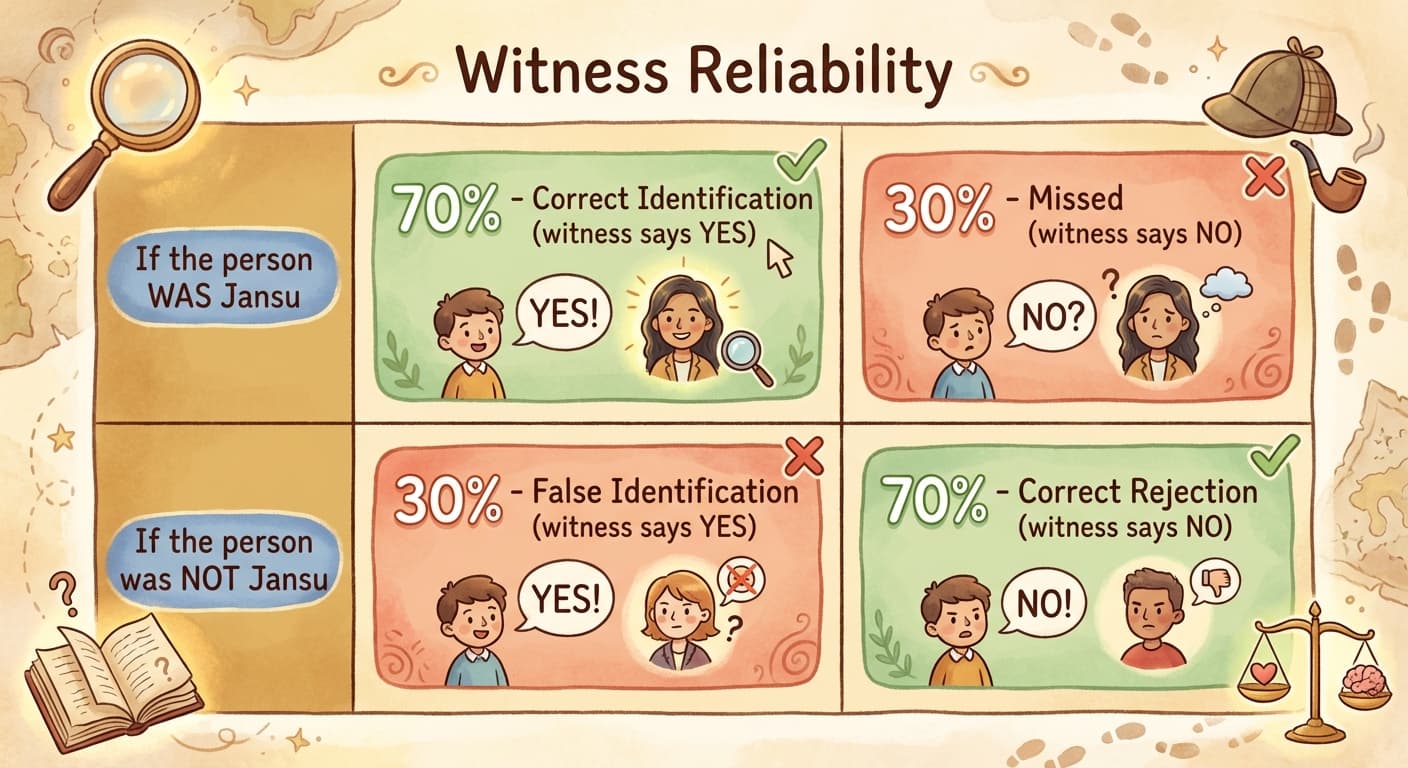
Glagalbagal: Let us think about it with numbers, the way we did with the village. Forget the murder for a moment. Suppose Hyjop sees someone walking down the street, and he thinks it is Jansu. We know he is right 70% of the time and wrong 30% of the time. Now, suppose that before the sighting, we thought there was a 5% chance Jansu would be in that area at 7pm — she says she went home, but maybe she came back.
Wrinje: Okay.
Glagalbagal: So out of 100 hypothetical versions of this evening, in 5 of them Jansu is actually there and in 95 she is not. In the 5 where she is there, Hyjop correctly identifies her 70% of the time — that is 3.5 times, let us say roughly 3 or 4. In the 95 where she is not there, Hyjop incorrectly thinks he sees her 30% of the time — that is about 28 or 29 times.
Wrinje: Wait. Twenty-eight or twenty-nine false identifications?
Glagalbagal: Yes. Because there are so many more situations where Jansu is not there, even a small error rate produces many false identifications. So Hyjop says "I saw Jansu" in about 32 out of 100 scenarios. But in only about 3 or 4 of those was Jansu actually there.
Wrinje: So the chance Jansu was actually there, given that Hyjop says he saw her, is only about 4 out of 32? That is... around 12%?
Glagalbagal: Roughly, yes. It depends on the exact numbers you use. But the point is that a 70% reliable witness does not give you a 70% chance of guilt. It gives you something much lower, because you have to account for how likely it was that Jansu was there in the first place.
Wrinje: That is really counterintuitive.
Glagalbagal: It is. And this is why eyewitness testimony alone is dangerous. It feels very convincing — someone looked at the suspect and said "that is the person." But the mathematics tells you to be more cautious.
Wrinje: But it does still raise the probability, right? Before the testimony, I had Jansu at maybe a few percent. Now it is around 12%?
Glagalbagal: Yes, it raises the probability. The testimony is not worthless — it does shift things. But it shifts them much less than most people assume. If you put Hyjop on a witness stand and he says "I saw Jansu there at 7pm," most jurors would treat that as near-certain proof. The actual evidential value is much more modest.
Wrinje: Mum is not going to like this. She was convinced this proved Jansu did it.
Glagalbagal: Your mother is in good company. Most people make the same error. They confuse "the witness is 70% reliable" with "there is a 70% chance the suspect is guilty." Those are completely different statements.
Wrinje: I think I need to find out more about what actually happened. The newspaper is not enough. I want to talk to people in the neighbourhood.
Glagalbagal: That is an excellent idea. Start with the shopkeeper himself. People who gossip for a living tend to know more than they put in their witness statements.
Vilila (from the other room): Are you still on the phone? I am timing this call.
Wrinje: Phone calls are free, Mum.
Vilila: Nothing is free, Wrinje. I thought you were learning about probability, not economics. Get off the phone.