
Part 8 of 18
The Prior
By Madhav Kaushish · Ages 12+
Glagalbagal came over for dinner that Saturday. Vilila had made Nsujala stew, which she claimed was a family recipe but which tasted suspiciously like something from a jar. Glagalbagal, as usual, supplemented her meal with raw limes.
Wrinje: I went to the neighbourhood and talked to Hyjop.
Glagalbagal: The eyewitness?
Wrinje: Yes. And he told me about three other people connected to Glerna. There is Fliba, her housekeeper who has a key to the house and came every day. Klimpan, the neighbor who has been fighting with Glerna about a fence. And Lagard, a handyman who was working at Glerna's house on the day of the murder.
Glagalbagal: So the suspect list has expanded.
Wrinje: Exactly. I realized I was only thinking about Jansu because the police arrested her. But there are at least four people with some connection to Glerna, plus the possibility that a stranger did it.
Glagalbagal: Good. This is very important. Before you look at any evidence, you need to consider all the possible explanations, not just the first one someone hands you. Now, let us try something. Can you assign a probability to each suspect?
Wrinje: Before looking at the evidence?
Glagalbagal: Yes. Based only on their relationship to Glerna and what you generally know about how murders happen. This is called the prior probability — it is your starting belief before you examine the specific evidence.
Wrinje: All right. Klimpan threatened Glerna publicly. He said he would tear her down. I would put him at 40%.
Glagalbagal: Why so high?
Wrinje: Because he threatened her. That is basically a confession.
Glagalbagal: People say things they do not mean all the time. Your mother threatens to have you adopted at least twice a week.
Vilila: Three times this week, actually.
Glagalbagal: And yet Wrinje remains unadopted.
Wrinje: Fine. But he is still suspicious.
Glagalbagal: You are assigning a high probability because the threat is dramatic and memorable. But think about what we know about murders in general. Are most murders committed by neighbors who made threats, or by people who had closer relationships with the victim?
Wrinje: Closer relationships, I suppose.
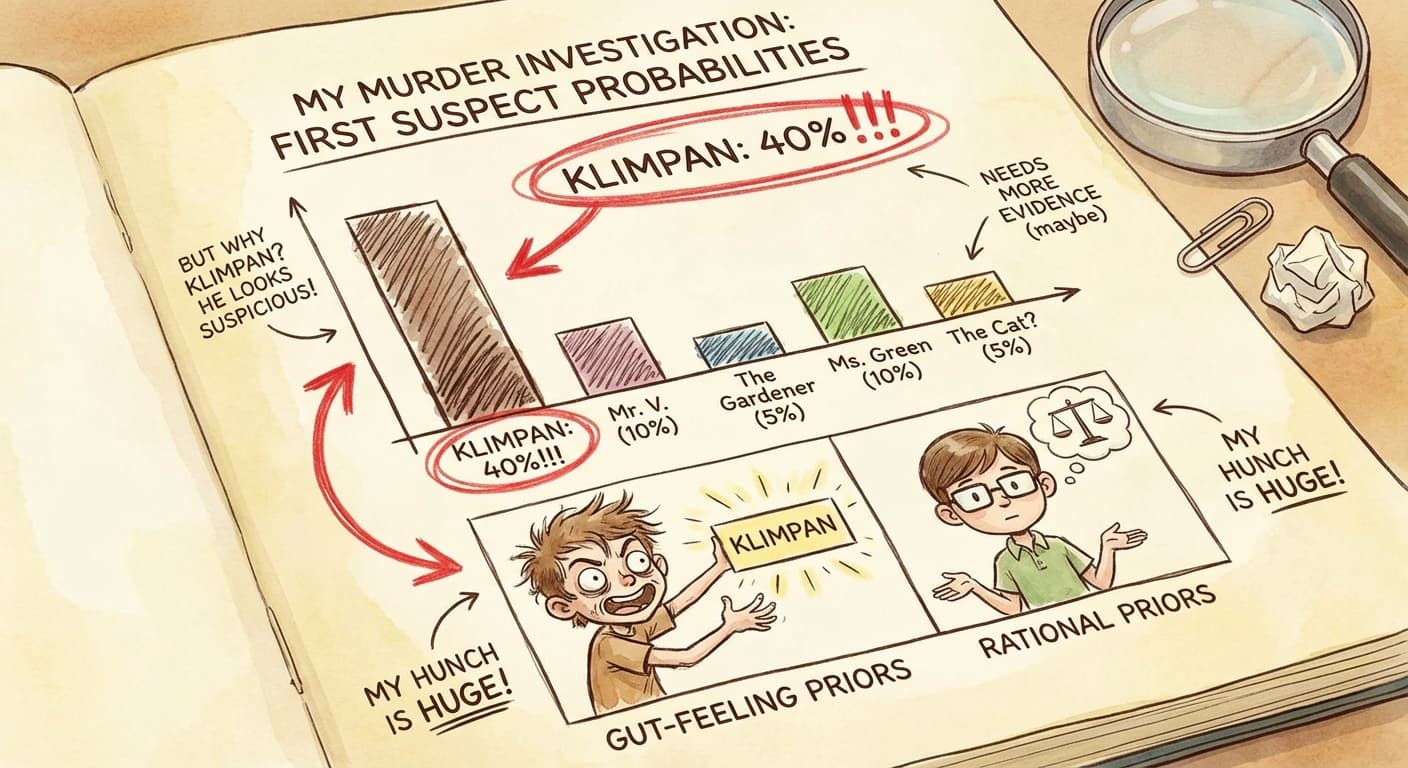
Glagalbagal: Let me suggest a different approach. Instead of going with your gut feeling about who seems most suspicious, think about the base rates. What do we know about who commits murders?
Wrinje: You told me that in our city, about 10% of murders are committed by people known to the victim.
Glagalbagal: Right. And the rest?
Wrinje: 90% by strangers, or at least people not known to the victim.
Glagalbagal: So before any specific evidence, there is a 90% chance the killer is someone not in your suspect list at all. That leaves 10% to be distributed among the people Glerna knew.
Wrinje: Only 10%?
Glagalbagal: For all the people she knew combined. Now, Glerna probably knew about 50 people to some degree. If we distributed that 10% equally, each person she knew would get 0.2%. But they should not be equal — some people had more access, more contact, more reason to be in the house.
Wrinje: So how do I distribute it?
Glagalbagal: Think about it in terms of access and proximity. Fliba was in the house every single day with her own key. Jansu visited occasionally as a niece. Klimpan lived next door but had no reason to be inside the house. Lagard was there for a specific job that week. Among these four, who had the most access?
Wrinje: Fliba, easily. She was there every day.
Glagalbagal: So a reasonable prior might give Fliba, say, 3% — the largest share among the known people, because daily access puts her in the most frequent contact. Jansu gets maybe 1% as a regular but less frequent visitor. Klimpan and Lagard get smaller amounts — perhaps half a percent each. That leaves the remaining percentage spread among Glerna's other acquaintances, and the large majority for unknown people.
Wrinje: Those numbers feel very low.
Glagalbagal: They should feel low. Before specific evidence, no single person is very likely to be the killer. That is the whole point. The prior reflects your state of uncertainty before you start investigating. It is supposed to be humble.
Wrinje: But I have already seen some evidence. The eyewitness testimony, the arrest...
Glagalbagal: Yes, and we will use those to update the priors. That is the next step. But I wanted you to see the priors clearly first because the mistake most people make — and you just made it — is to let their gut feelings contaminate the starting point. You wanted to put Klimpan at 40% because his threat was vivid and scary. But vividness is not evidence. A dramatic threat from a grumpy neighbor is less statistically meaningful than daily unsupervised access to the victim's home.
Wrinje: So my gut was wrong.
Glagalbagal: Your gut was doing what guts do. It was responding to what is dramatic rather than what is likely. This is why we use numbers instead of feelings.
Vilila: If you used numbers instead of feelings, you would never have children.
Glagalbagal: That is probably true.